Siyu Sun#, Yueyan Zhang#, Zhikang Han, Chengjing Liu, Bai Sun, Wei Zhang, Gang He*. Angew. Chem. Int. Ed. 2025, e23345. DOI: 10.1002/anie.202523345
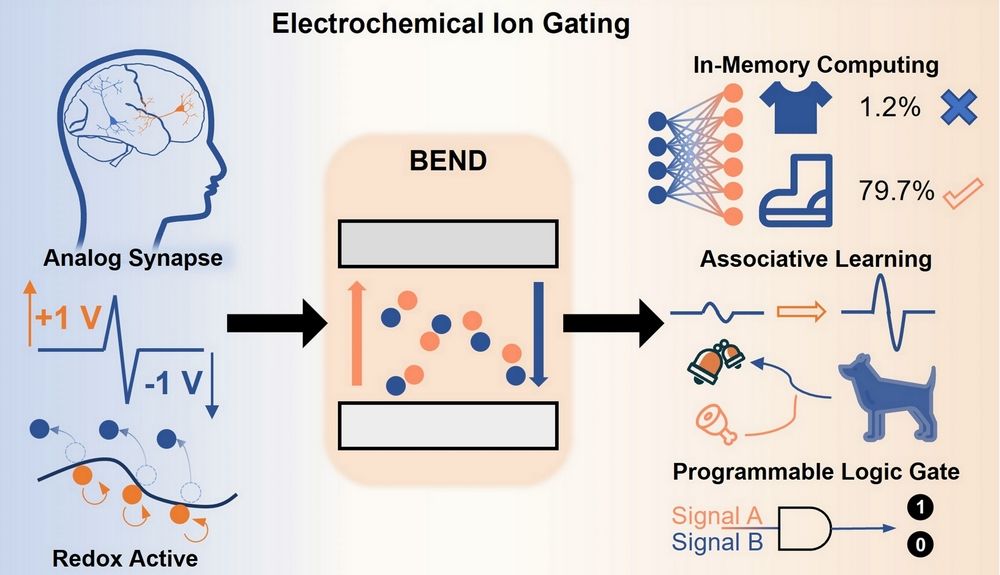
Neuromorphic computing takes inspiration from how biological nervous systems process information and aims to overcome the energy and efficiency bottlenecks imposed by the “memory–computing separation” in conventional von Neumann architectures. Electrochemical ion-gated devices, enabled by intrinsic ion–electron coupling, can modulate analog conductance in a continuously tunable manner that closely resembles biological synapses, and are therefore regarded as a key route toward low-power, in-memory brain-inspired hardware. However, to advance toward realistic computing tasks and scalable integration, these devices still face critical challenges at both the materials and device levels, including stable and reproducible ion-gating responses under low operating voltages, as well as endurance and consistency during long-term cycling.
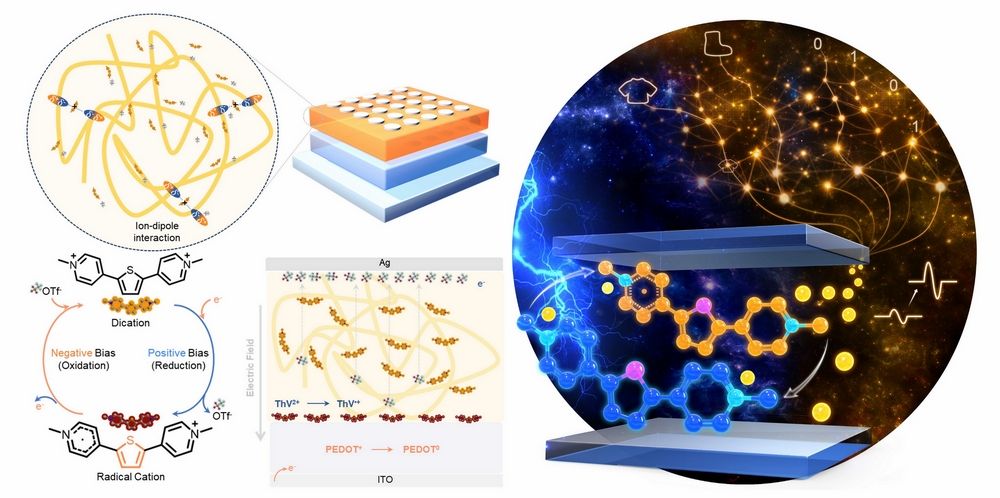
To address these issues, we introduced thiophene units into a viologen framework to construct a thienoviologen platform and, based on this design, developed an electrochemical neuromorphic device. This molecular structure effectively tunes the electronic structure and electrochemical activity, reducing the bandgap to 3.47 eV and yielding a more uniform charge distribution. As a result, the radical state is stabilized and the coupling between low-voltage reversible redox processes and ion migration is promoted. The device delivers continuously adjustable conductance and reliable ion-gating modulation within a ±1 V operating window, enabling synapse-like behaviors and exhibiting outstanding endurance on the order of 100,000 programming pulses. Beyond basic synaptic emulation, the device further demonstrates representative neuromorphic functions, such as spike-timing-dependent plasticity (STDP) and associative learning circuits, and supports two-terminal logic operations including NAND and XOR, highlighting its potential for integrated “learning-and-computing” functionality. For application-oriented validation, the device serves as an analog synaptic weight element in convolutional neural network–related computing tasks, achieving favorable accuracy and robustness on benchmark image-recognition datasets. Collectively, these results underscore the promise of viologen-derived systems for low-power neuromorphic computing and organic intelligent electronics.
First Authors: Sun Siyu, doctoral candidate, Assoc. Prof. Zhang Yueyan, Xi’an Jiaotong University
Correspondence Author: Prof. He Gang, Xi’an Jiaotong University
Full Text Link: :https://onlinelibrary.wiley.com/doi/10.1002/anie.202523345





 Latest Updates
 Hot Text Ranking