Fluorescent film-based sensors (FFSs) have emerged as powerful platforms for on-site, real-time detection of trace analytes in environmental monitoring, public safety, and health diagnostics. The performance of FFSs is intrinsically linked to the molecular design of the fluorescent film. An ideal film must exhibit high sensitivity, selectivity, stability, reversibility, and rapid response. However, conventional polycyclic aromatic hydrocarbons (PAHs) face inherent limitations: they often suffer from aggregation-caused quenching (ACQ) due to π–π stacking, leading to weak solid-state fluorescence and poor photostability. Moreover, sensing complex samples typically requires high-density sensor arrays, increasing device dimensions and hindering portability. Therefore, developing fluorescent units with high microenvironment sensitivity and multi-signal output capacity is essential for enabling single-fluorophore-based sensing arrays—a key goal for miniaturization without sacrificing performance.
Herein, we report a donor–acceptor (D–A) BODIPY derivative, BDP1, designed to address these challenges. Triphenylamine (TPA) donors are introduced at the 2- and 6-positions of the BODIPY core, creating a well-defined D–A architecture with strong intramolecular charge transfer (ICT) character. This renders BDP1 highly sensitive to microenvironmental polarity, enabling analyte discrimination through multi-signal responses, including emission wavelength shifts and intensity changes. A cholesteryl unit at the meso-position facilitates co-assembly with a small-molecule gelator (C1), yielding a nanostructured fluorescent film that effectively suppresses ACQ and photobleaching commonly observed in solid-state fluorophores. The resulting BDP1/C1 film exhibits sensitivity and response/recovery kinetics comparable to existing systems, while offering two distinct advantages: (i) responsiveness to volatile organic compound (VOC) vapors across a significantly wider polarity range, and (ii) the capability to discriminate among seven different VOCs—transcending the single-analyte detection limit of most conventional systems. This work demonstrates the potential of rationally designed single-fluorophore platforms for advanced multi-analyte sensing.
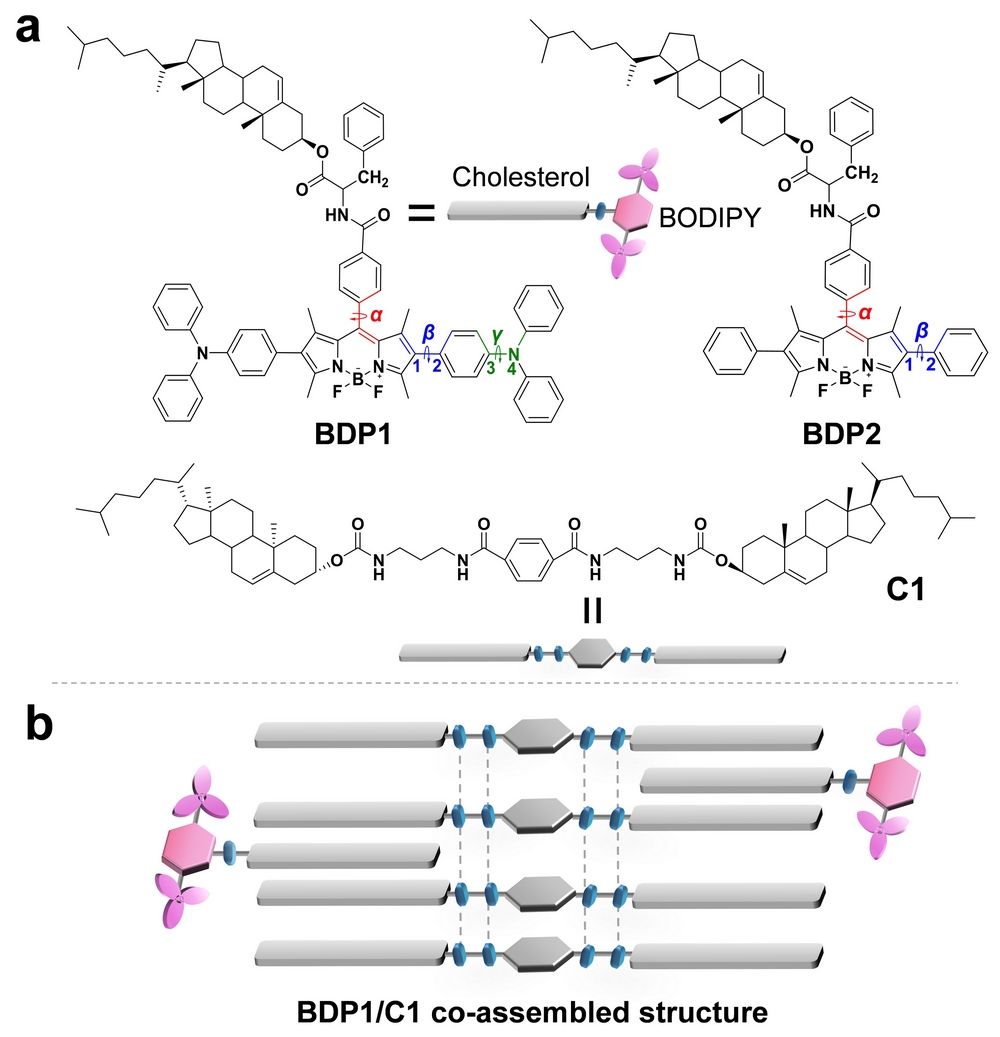
Fig. 1 (a) Chemical structures of BDP1, BDP2, and C1. (b) Schematic illustration of the BDP1/C1 co�assembly structure.
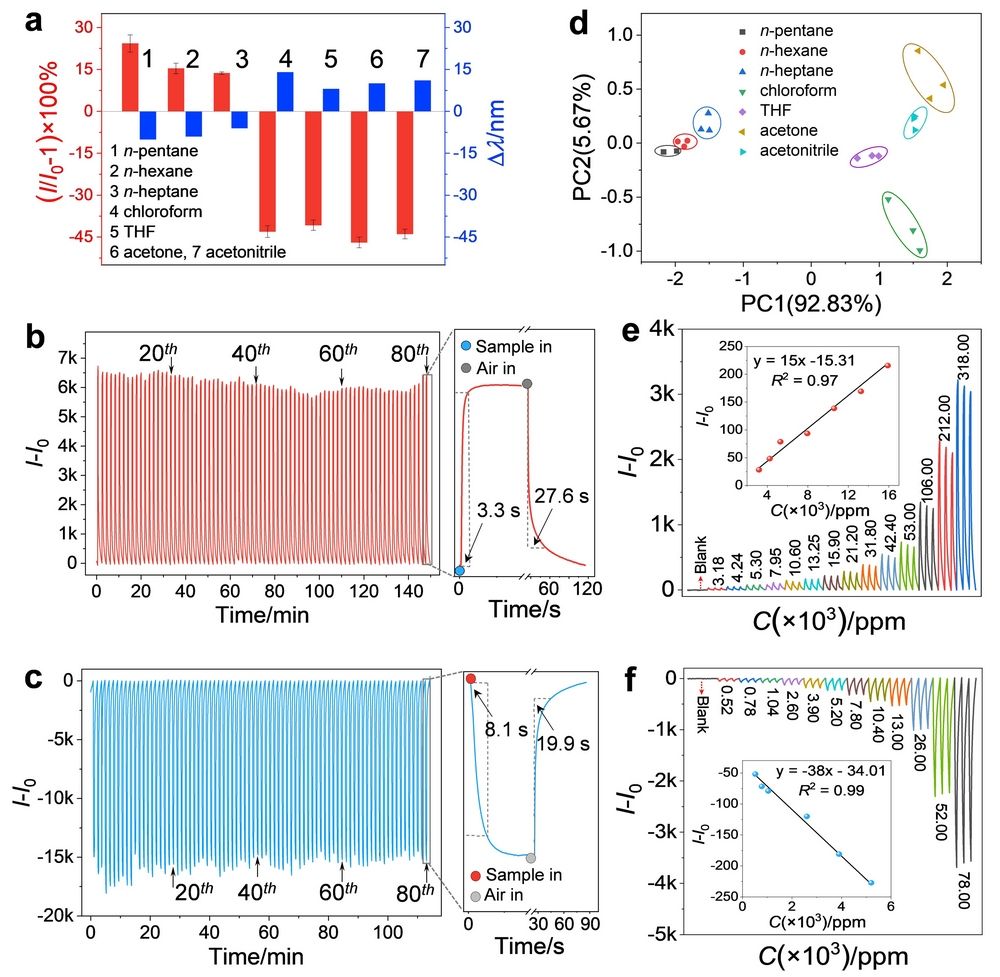
Fig. 2 Fluorescence responses of the BDP1/C1 fluorescent nanofilm to seven VOCs with different polarities and their discrimination analysis
First Author: An Nan, master’s student, Shaanxi Normal University
Correspondence Author: Prof. Liu Jing, Shaanxi Normal University
Full Text Link: https://pubs.rsc.org/en-gb/content/articlepdf/2026/cc/d6cc00672h





 Latest Updates
 Hot Text Ranking