Shufei Li, Yibo Zhao, Jinghua Yu, Gang Wang*, Taihong Liu*, Liping Ding, and Yu Fang. Dyes Pigments, 2026, 251, 113757, DOI: 10.1016/j.dyepig.2026.113757
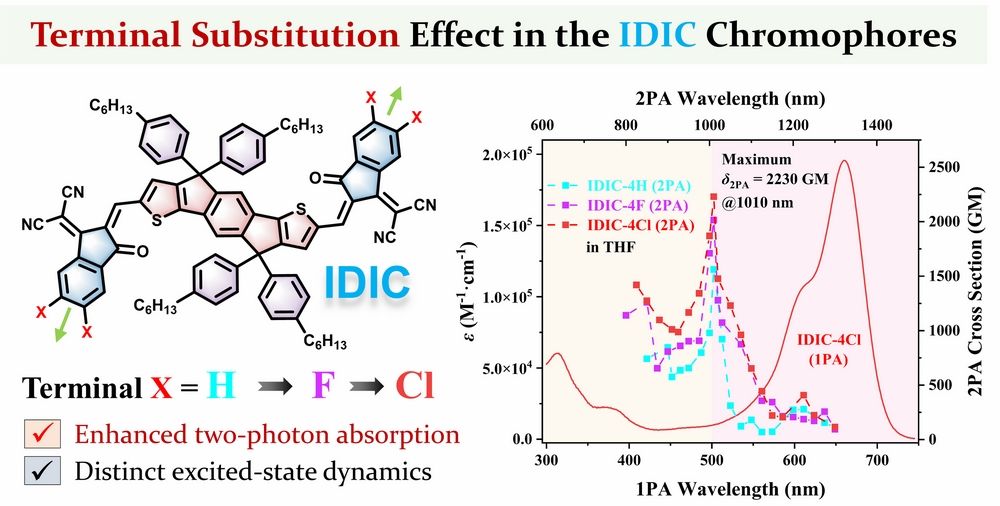
Versatile modification of conjugated chromophores is crucial for pronounced intramolecular charge transfer (ICT) and favorable transition diploe moments in nonlinear optics. Herein, the resultant correlation between the terminal substitution effects of IDIC chromophores [bis(1,1-dicyanomethylene-3-indanonyl)-terminated-indacenodithiophene] and their photophysical properties was comparatively investigated. Halogenated IDIC chromophores, namely IDIC-4F and IDIC-4Cl, feature the quadrupolar acceptor-donor-acceptor structural motifs and exhibit significant spectral red-shifts in comparison with the parent counterpart of IDIC-4H. It implies enhanced electron-withdrawing ability of the acceptor achieved by the F/Cl substituents. Characterized by the typical open-aperture Z-scan measurements, IDIC-4Cl presents a two-photon absorption (2PA) cross-section (δ2PA) maximum of 2230 GM (1 GM ≡ 10−50 cm4⋅s⋅photon−1⋅molecule−1) at the specific wavelength of 1010 nm in the NIR-II spectral region, which is significantly higher than that of IDIC-4H (δ2PA = 1516 GM). Electron-withdrawing terminal halogenation is proved to be responsible for the enhanced 2PA capacities. DFT calculations corroborate that the frontier orbital energy levels as well as the bandgaps decrease following the electron-withdrawing trend of H→F→Cl. Ultrafast transient absorption spectroscopies further reveal that halogenated IDIC chromophores possess reactively low excited-state energy levels and strong ICT effects, which contribute to improving their 2PA capabilities. Leveraging these features, this study deepens the understanding of terminal halogenation effect on the transition dynamics and nonlinear 2PA properties of the quadrupolar IDIC chromophores.
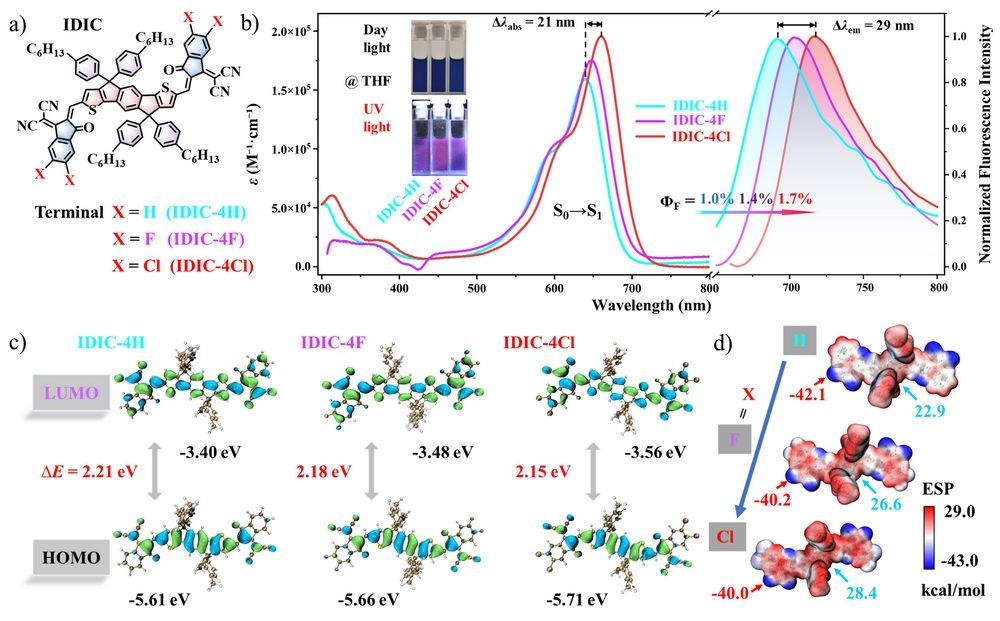
Figure 1. Molecular structures and steady-state spectra of the three IDIC chromophores, along with their frontier molecular orbital distributions and ESP maps.
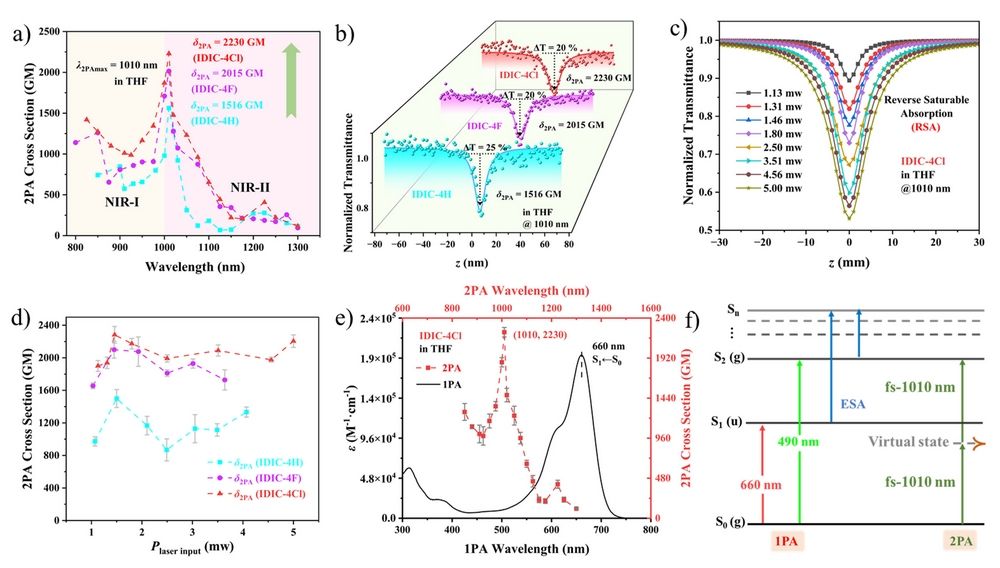
Figure 2. Nonlinear optical properties of the three IDIC chromophores.
First Author: Li Shufei, doctoral candidate, Shaanxi Normal University.
Correspondence Authors: Prof. Liu Taihong, Shaanxi Normal University; Prof. Wang Gang, Xi’an University
Full Text Link: https://doi.org/10.1016/j.dyepig.2026.113757





 Latest Updates
 Hot Text Ranking