Xin-Ao Liu, Xingtong Zhou, Tong Zhang, Congdi Shang, Liping Ding, Taihong Liu and Yu Fang. Chem. Sci., 2026, https://doi.org/10.1039/D6SC00573J
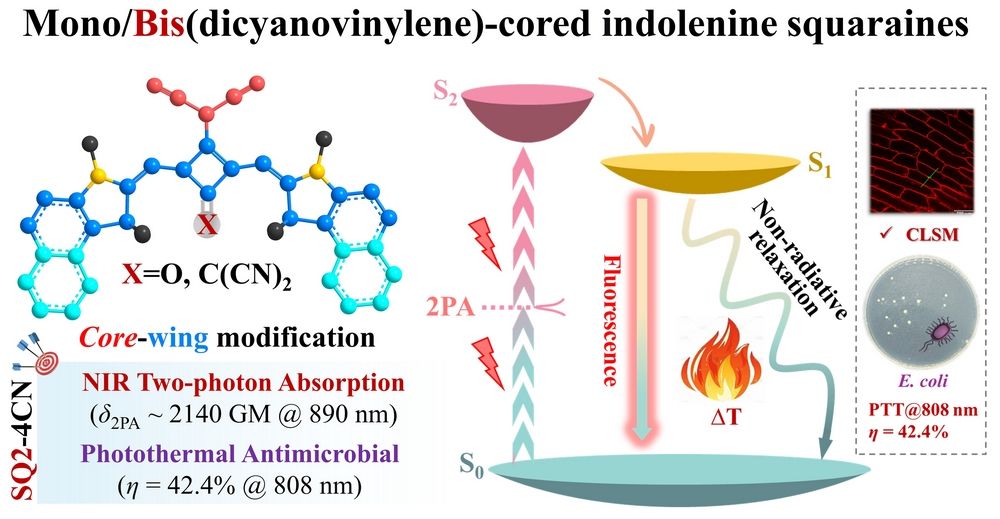
Predictable structure-property relationships for the near-infrared (NIR)-emitting chromophores and sustainable photothermal agents remain challenging. Herein, two series of indolenine-based squaraines are synthesized to investigate the core-wing structural modulation corresponding to the photophysical properties. Dicyanovinylene modification on the squaraine carbonyl core induces substantial bathochromic shift and enriches the de-activation pathways, while further wing functionalization strengthens the intramolecular charge transfer (ICT) efficiency and enhances the nonlinear two-photon absorption (2PA). Intrinsic zwitterionic stabilization and bent-shaped molecular skeleton of the bis(dicyanovinylene)-cored squaraines are accompanied theoretically. Optimal benzindolenine-winged squaraine dye SQ2-4CN demonstrates a strong two-photon absorption cross section (δ2PA) of 2140 GM at 890 nm within the NIR biological spectral window, approximately 8.95-fold enhancement over that of the indolenine-winged counterpart SQ1-2O. Femtosecond transient absorption spectroscopies further reveal the ICT character and plausible excited-state dynamics. Moreover, efficient bio-staining capability and photothermal eradication of bacteria with a significant photothermal conversion efficiency of 42.4% under 808 nm laser irradiation are initially validated for SQ2-4CN. The present work opens a pathway for designing core/wing-modified squaraines with superior nonlinear optical properties for potential bioimaging and photothermal applications.
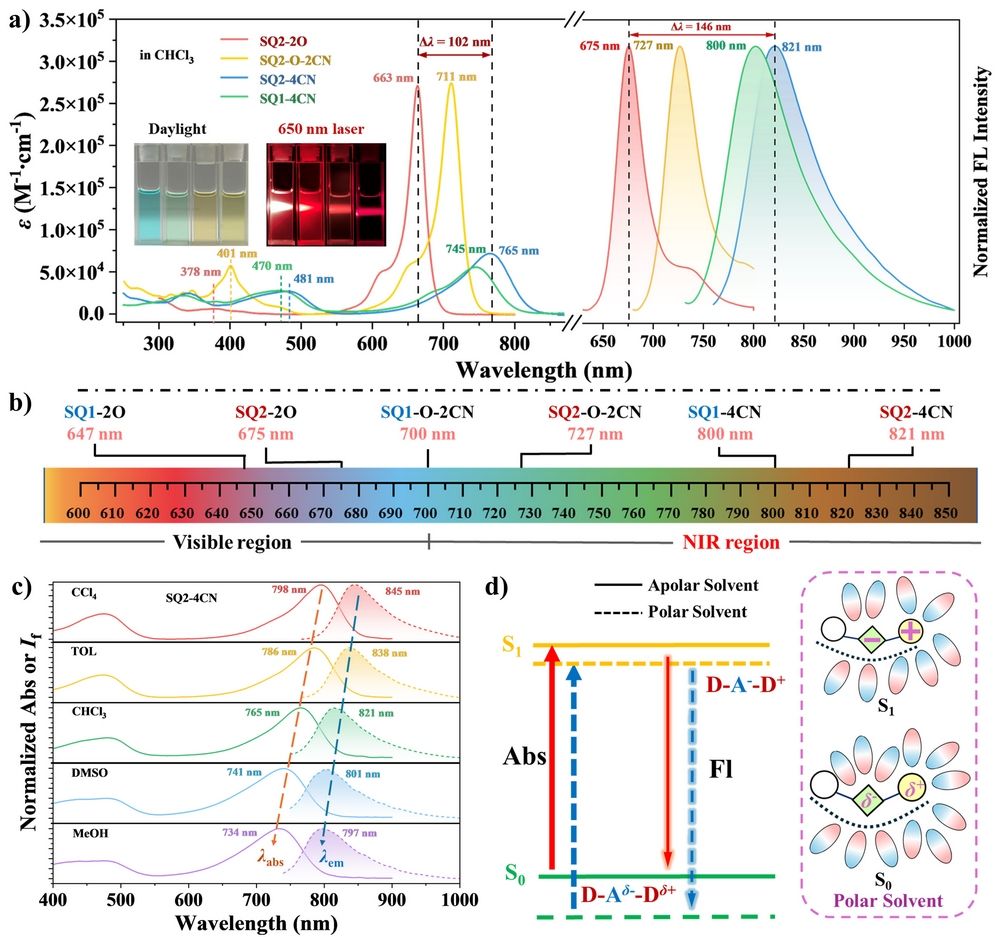
Figure 1 (a) Steady-state spectra of the SQ2 series and SQ1-4CN in CHCl3 solution. (b) Fluorescence peak distribution of SQs in CHCl3. (c) Normalized absorption (solid lines) and emission (dashed lines) spectra of SQ2-4CN in different organic solvents. (d) Schematic illustration of the effect of solvent polarity on the photoexcitation process of SQ2-4CN.
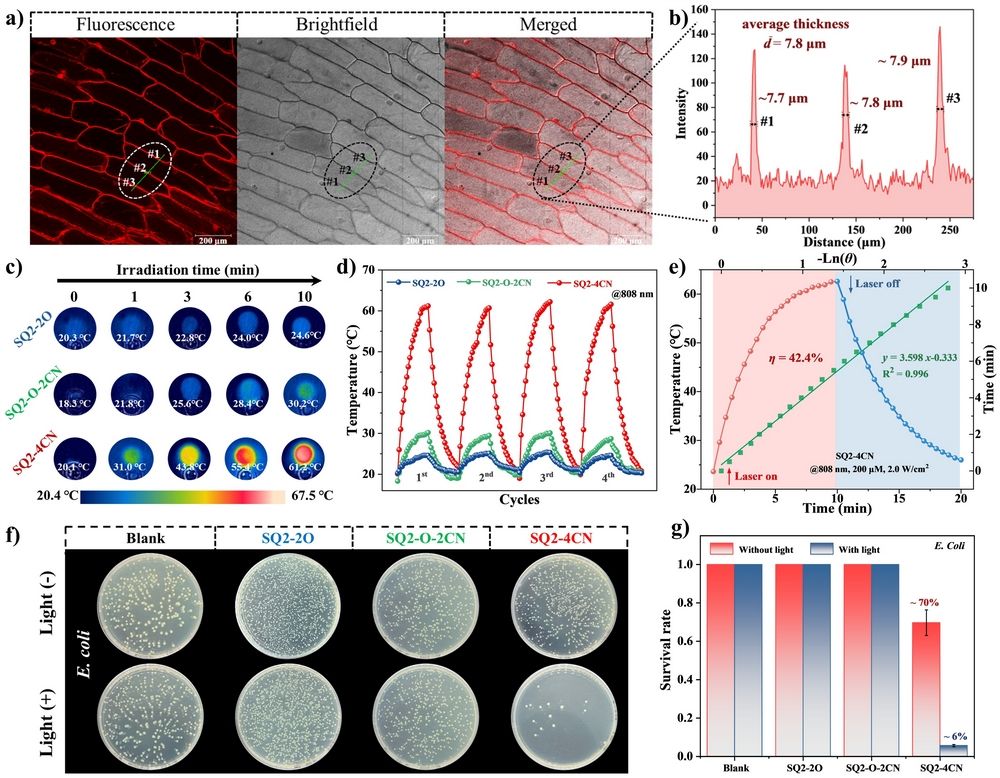
Fig. 2 (a) CLSM images of onion epidermal cells incubated with SQ2-4CN. (b) Spectral intensity analysis of onion epidermal cells stained with SQ2-4CN. (c) Infrared thermographic images of the SQ2 series in DMSO solution under laser irradiation at different time points. (d) Temperature variation of the SQ2 series over four irradiation/cooling cycles (808 nm, 1.5 W/cm2, 10 min). (e) Heating/cooling curves and the plot of cooling time versus -ln(θ). (f) Comparison of the visualization effect on E. coli colonies in the presence of the SQ2 series. (g) Survival rate of E. coli co-cultured with the SQ2s under 808 nm laser irradiation.
First Author: Liu Xin’ao, master’s student, Shaanxi Normal University
Correspondence Authors: Prof. Liu Taihong and Prof.Ding Liping, Shaanxi Normal University; Assoc. Prof. Shang Congdi, Northwest A&F University
Full Text Link: https://doi.org/10.1039/D6SC00573J




 Latest Updates
 Hot Text Ranking