Wendan Luo, Yijia Chen, Jinghua Yu, Chun Yang*, Zhiyan Huang, Taihong Liu*, Liping Ding, and Yu Fang. Anal. Chem., 2026, DOI: https://doi.org/10.1021/acs.analchem.6c00915
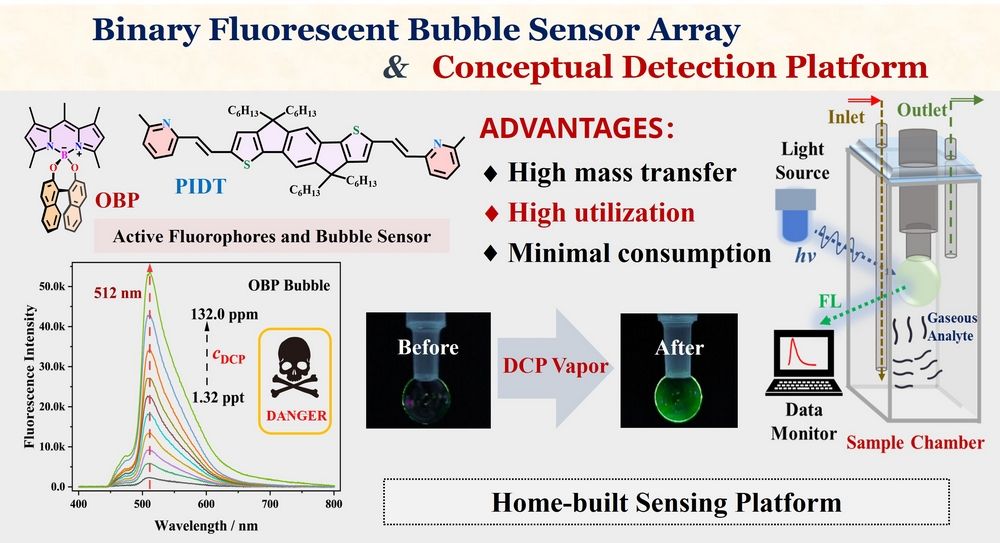
The development of a reliable platform for rapid and sensitive detection of hazardous substances has always been a core research direction in the fields of public security, environmental monitoring, and anti-terrorism and chemical defense. Fluorescent Bubble Sensor and droplet microreactors have attracted extensive attention in the field of rapid detection in recent years due to their inherent advantages such as high mass transfer efficiency, large surface area-to-volume ratio, and efficient utilization of active substances. Herein, two active fluorophores based on the 4,4-diaryloxy BODIPY derivative (abbreviated as OBP) and 4,4,9,9-tetrahexyl-4,9-dihydro-s-indaceno[1,2-b:5,6-b']dithiophene pyridine derivative (PIDT) were synthesized and fully characterized. Their sensing performance and related sensing mechanisms in the solution media for diethylchlorophosphate (DCP), a typical nerve agent simulant, were initially evaluated with the aid of theoretical calculations. Subsequently, two corresponding bubble sensors were optimized by doping the two fluorophores (OBP and PIDT) into the stock bubble solution. The components in the latter stock bubble solution were optimized as the mixtures of sodium dodecylbenzene sulfonate (SDBS), glycerol, and water. The life span and robustness of the optimal bubbles suite for the further detection application. A compact sensing platform based on the optical bubble sensors was further fabricated for evaluating the detection of gaseous DCP and acid interferents. Fast turn-on sensing response targeting gaseous DCP was investigated properly. Compared with homogeneous detection in droplets, the fluorescent bubble sensor exhibits a significant 24.9-fold signal amplification capability. It can detect gaseous DCP at a concentration as low as 1.32 ppt, with higher sensitivity than most reported optical sensors. Meanwhile, the underlying sensing mechanism of the fluorescent bubble sensor was theoretically explained through the mass transfer dynamics and sequential phase-transfer processes. Importantly, enhanced sensing performances and discrimination of DCP from the acid interferences were achieved properly based on a binary-component bubble sensor. This work first presents a bubble sensor array for detecting gaseous nerve agent simulants and fabricates a compact platform for evaluating sensing performances. This approach advances sustainable gas detection applications, and aligns with the emerging integration of portable devices for detecting hazardous substances.
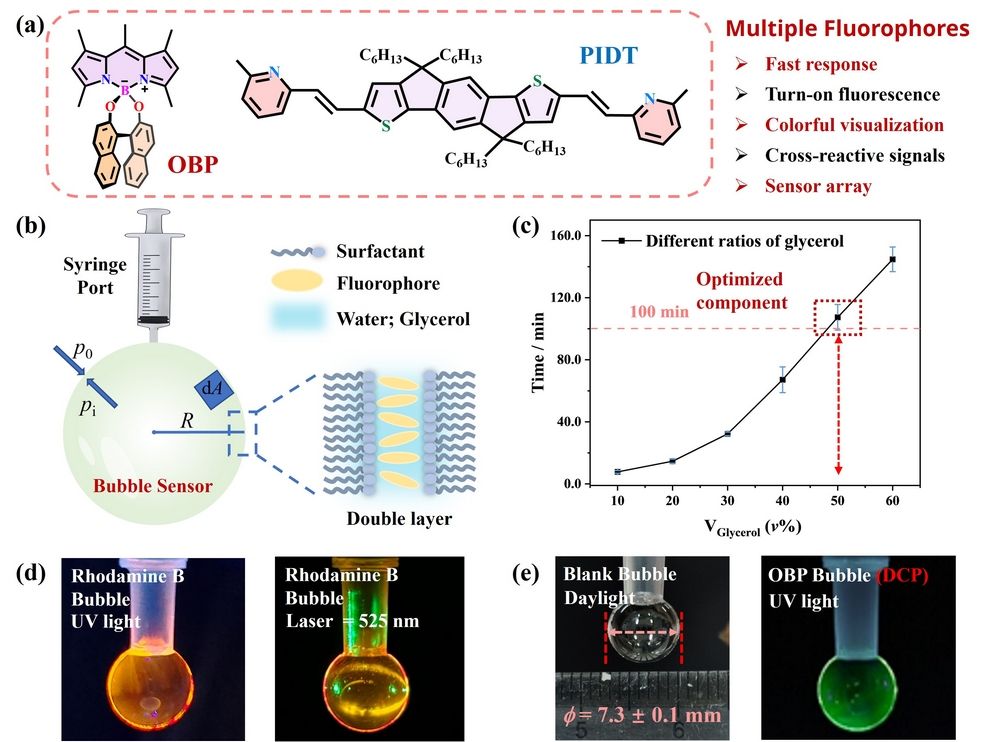
Figure 1. Molecular formulas of the two active fluorophores OBP and PIDT; Schematic diagram and photographic images of the bubble structures.
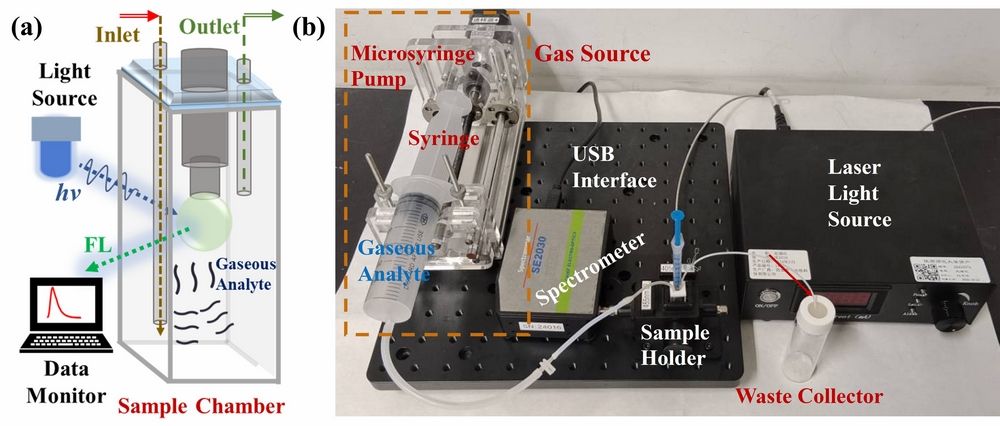
Figure 2. Schematic sample chamber containing the bubble sensor and gaseous analyte; Photograph of the home-built bubble sensing platform.
First Author: Luo Wendan, Master’s student, Shaanxi Normal University
Correspondence Authors: Prof. Liu Taihong, Shaanxi Normal University; Engineer Yang Chun, National Anti-Drug Laboratory Shaanxi Regional Center
Full Text Link: https://doi.org/10.1021/acs.analchem.6c00915





 Latest Updates
 Hot Text Ranking