Yan Luo, Lejie Liu, Qingtong Wu, Hongtao Li, Ruijuan Wen, Jinglun Yang, Chun Yang, Yangtao Shao, Ling-Ya Peng*, Liping Ding*, Yu Fang*. Angew. Chem. Int. Ed., 2026, doi.org/10.1002/anie.5244392
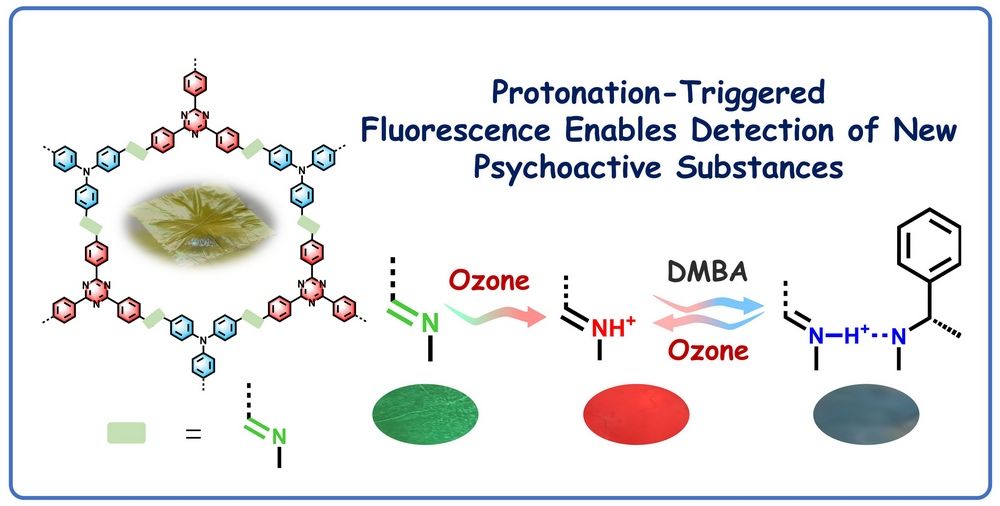
New psychoactive substances (NPS) typically exhibit low saturated vapor concentrations and are susceptible to interference such as water vapor and carbon dioxide, making the realization of high-performance gas-phase detection a challenge in both scientific research and public safety. Herein, we presented a self-standing covalent organic framework (COF) membrane formed between 1,3,5-tris-(4-aminophenyl)triazine (TTPA) and 4,4',4''-nitrilotribenzaldehyde (TFPA), TTPA–TFPA COF, which was fabricated via a two-step synthesis involving interface-confined polymerization followed by post-processing. The sensor used the ozone-treated COF membrane as the sensing layer exhibited rapid, highly selective, and visually observable fluorescence response toward the NPS simulant (S)-N,α-dimethylbenzylamine (DMBA), achieving a fast response time of less than 1 min and an ultra-low detection limit of 2.1 ppb. Moreover, the sensor successfully discriminates seven structurally analogous NPS reference standards through kinetic response profiling. The infrared and XPS spectra, along with theoretical calculations, further reveal the sensing mechanism is driven by hydrogen bond interaction between the ozone-treated COF membrane and the DMBA. These findings offer valuable insights for developing portable, real-time chemical monitoring devices, providing an innovative solution for on-site trace-level NPS detection. This holds promising potential for addressing serious threats to human health, family harmony, and social stability.
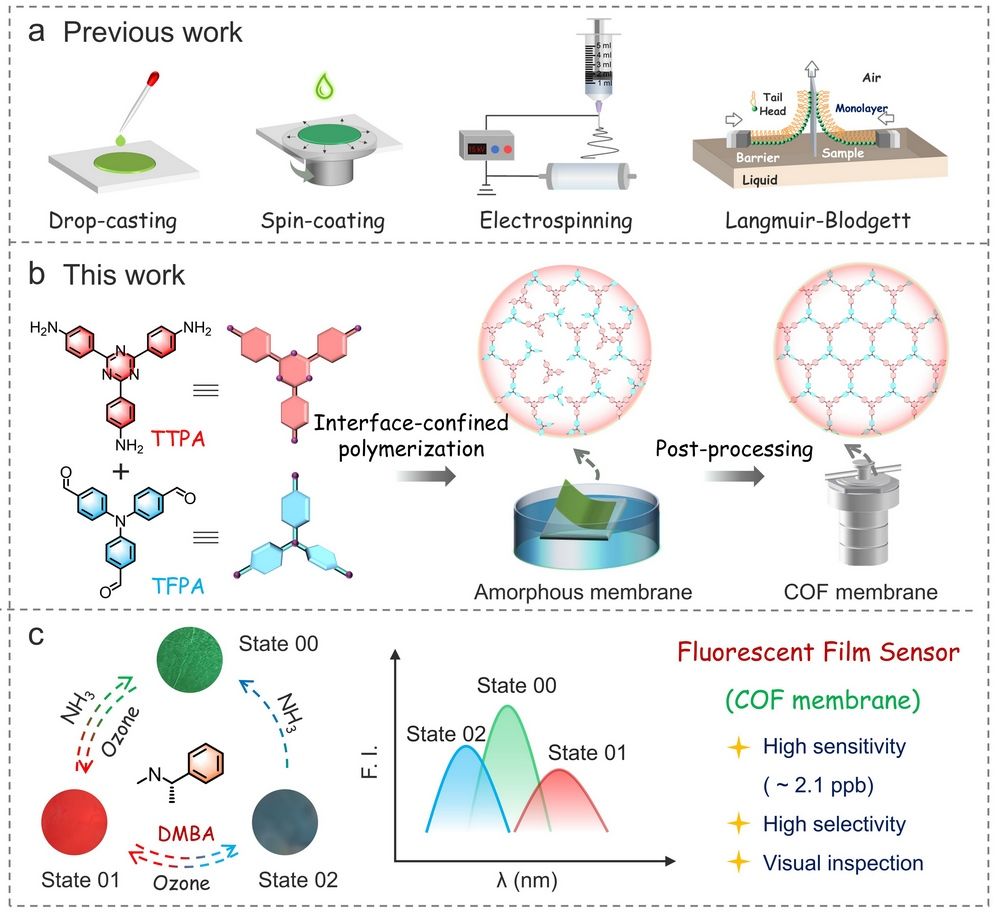
Figure 1. (a) Representative methods for the preparation of fluorescent sensing films; (b) Structures of TTPA and TFPA, along with a schematic illustration of the preparation process for TTPA–TFPA COF membrane; (c) Schematic illustration of the response of TTPA–TFPA COF membrane to ozone, DMBA, and NH3.
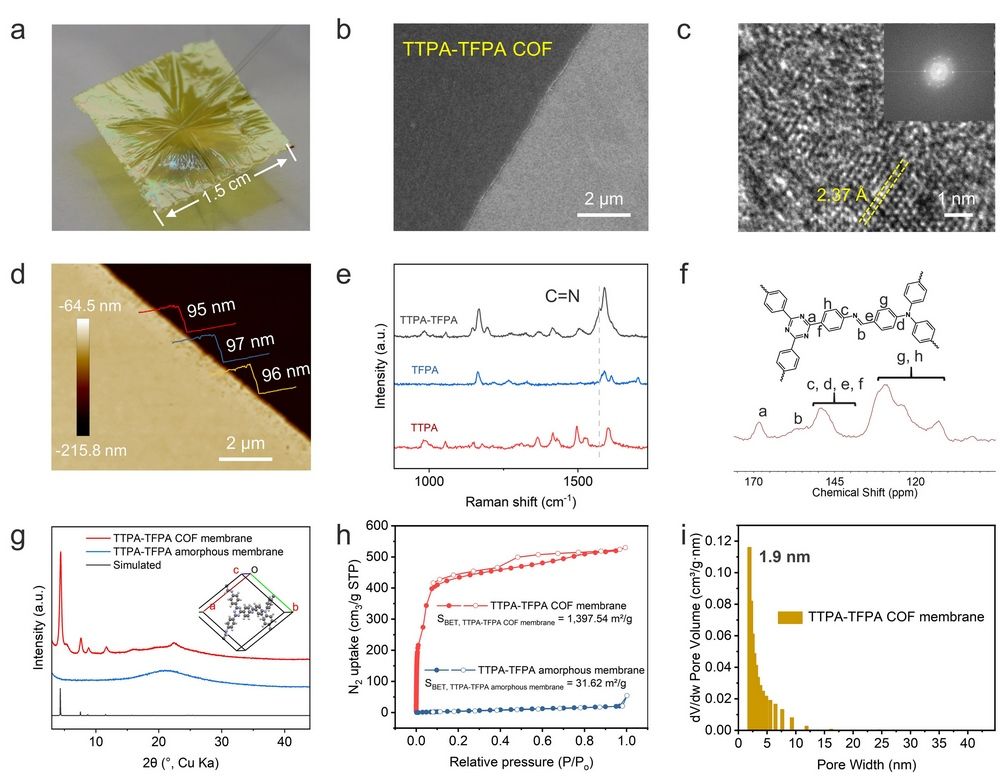
Figure 2. Images and characterization of the TTPA–TFPA COF membrane.
First Author: Luo Yan, doctoral candidate, Shaanxi Normal University
Correspondence Authors: Prof. Fang Yu, Prof. Ding Liping and Dr. Peng Lingya, Shaanxi Normal University
Full Text Link: https://doi.org/10.1002/anie.5244392





 Latest Updates
 Hot Text Ranking