Xin Bo*, Somnath Mukherjee, Ziyi Yan, Kamran Dastafkan, Zenglin Wang*, Chuan Zhao*, J. Mater. Chem. A, 2026, DOI: 10.1039/D6TA00691D
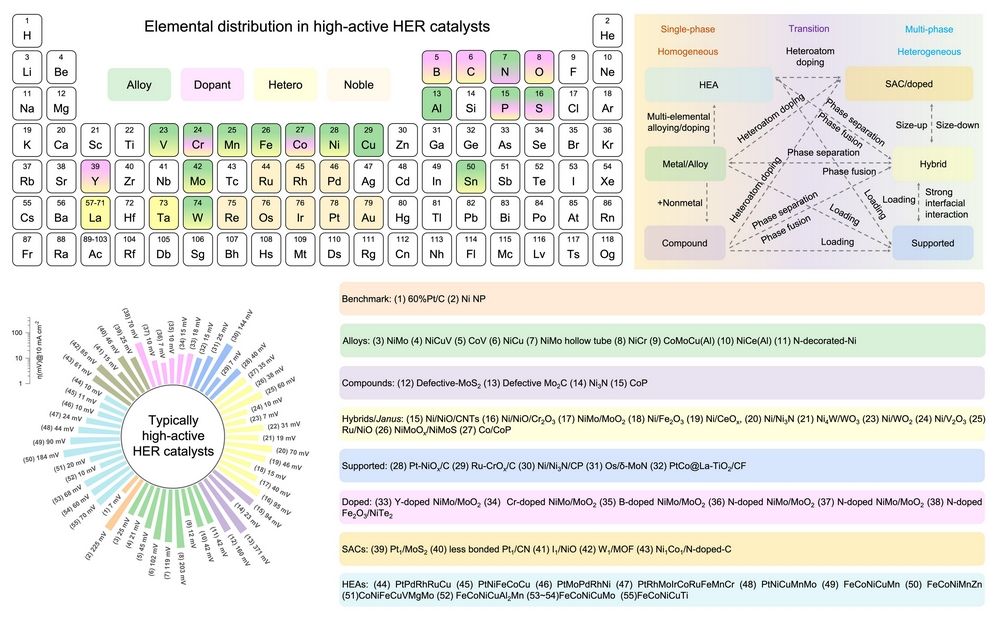
The development of highly efficient electrocatalysts for the hydrogen evolution reaction (HER) represents a cornerstone for sustainable hydrogen production via water electrolysis in basic media. This field is remarkably dynamic, with an annual deluge of publications exploring a vast range of materials. This proliferation of designs presents a highly diversified landscape, yet a fundamental dichotomy persists in the conceptual approaches: the homogeneous single-phase vs. the heterogeneous multi-phase. This review systematically categorizes and critically discusses typical examples from single- phase to multi-phase catalysts for HER. Importantly, as we navigate this classification, we are prompted to reflect on a profound and often ambiguous intersection between them. On a certain level, the design principles for homogeneous and heterogeneous catalysts exhibit a relationship of opposition and unity.
Therefore, this review aims not only to provide a comprehensive overview of the current landscape but also to stimulate deeper contemplation within the research community: at what critical scale do the defining characteristics of homogeneous and heterogeneous catalysts converge? Probing this fundamental issue is anticipated to foster the development of more accurate quantitative descriptors for catalytic behaviour at interfaces, ultimately guiding the rational design of advanced materials and unifying theoretical frameworks that transcend the traditional homogeneous/heterogeneous divide.
First Author: A/Prof. Bo Xin, Shaanxi Normal University
Correspondence Authors: A/Prof. Bo Xin, Prof. Wang Zenglin, Shaanxi Normal University; Prof. Chuan Zhao, University of New South Wales
Full Text Link: https://doi.org/10.1039/D6TA00691D





 Latest Updates
 Hot Text Ranking