Kaixiang Cui, Keyu Xie, Haonan Peng*, Liping Ding*, Yu Fang. Nano Research, 2026, https://doi.org/10.26599/NR.2026.94908629
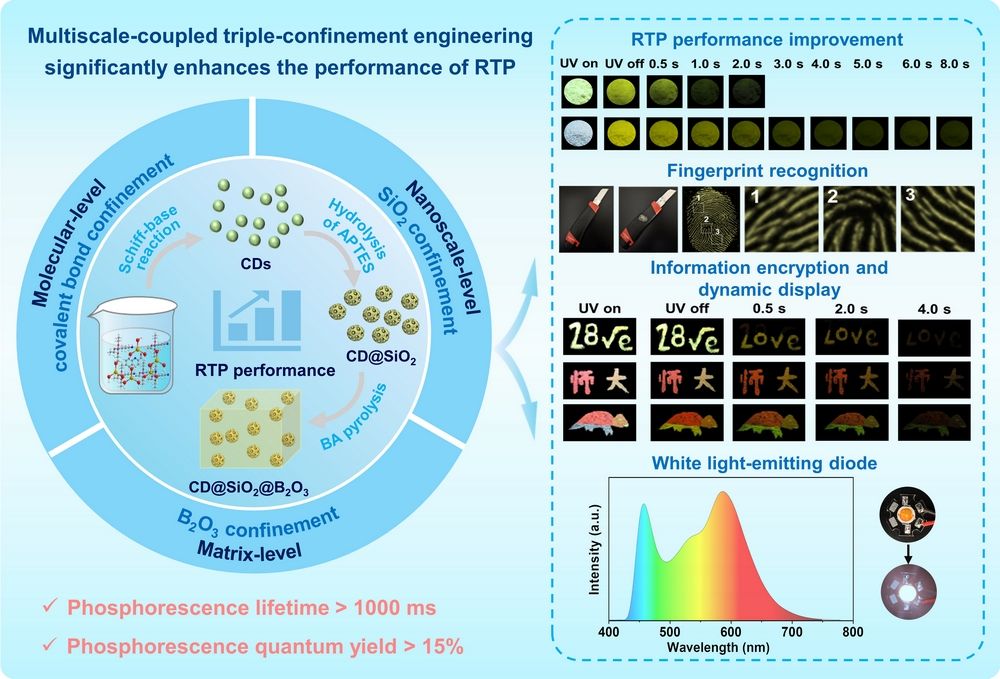
Room-temperature phosphorescence (RTP) materials possess advantages such as long lifetime and resistance to background interference, and thus have great potential for applications in information encryption, anti-counterfeiting, biological imaging, and optoelectronic devices. Carbon dots (CDs), as a new type of zero-dimensional carbon nanomaterial that is green, non-toxic, and easily modifiable, are an ideal choice for developing metal-free RTP systems. However, achieving efficient and long-lived RTP properties of CDs still poses significant challenges. The reasons are as follows: (1) Weak spin-orbit coupling, which hinders the effective transition from the singlet state to the triplet state; (2) Rapid non-radiative transitions driven by molecular vibrations and oxygen quenching; and (3) Aggregation-induced quenching effect in solid-state systems. Embedding CDs into a rigid matrix has been proven to effectively limit molecular motion and suppress non-radiative transitions. However, traditional single-domain confinement strategies are difficult to simultaneously balance intermolecular hopping enhancement and non-radiative decay suppression, with lifetime and quantum yield being mutually restrictive, becoming the core bottleneck for RTP carbon dots to move towards practical applications.
In response to these challenges, this work proposes a multi-scale coupled triple confinement strategy, namely synchronous integration of molecular-level covalent bond locking, nanoscale SiO2 coating, and matrix-level B2O3 rigidification, which enables the preparation of high-performance room-temperature phosphorescent carbon dot materials. This design effectively decouples the competition between ISC enhancement and non-radiative transition suppression, achieving nonlinear synergistic enhancement, with a synergy index S of 2.4. The composite material exhibits excellent performance: phosphorescence lifetime of 1120 ms, quantum yield of 25.98%, which are 3.8 times and 1.7 times higher than those of the single confinement system, respectively. This strategy has good universality and is applicable to different carbon sources and silane reagent systems. By means of phosphorescence resonance energy transfer (PRET), only 1% of commercial dyes can be incorporated to achieve multi-color room-temperature phosphorescence tunability, breaking the traditional limit of carbon dot emission colors. Based on its excellent optical properties, this material is successfully applied in second-level time-gated information encryption, high-contrast fingerprint recognition, and warm white LED without commercial fluorescent powder. This work establishes a general design principle of multi-scale coupled confinement, providing a new path for the development and application of high-performance metal-free room-temperature phosphorescent carbon dots.
First Author: Cui Kaixiang, doctoral candidate, Shaanxi Normal University
Correspondence Authors: Prof. Ding Liping and Prof. Peng Haonan, Shaanxi Normal University
Full Text Link: https://www.sciopen.com/article/10.26599/NR.2026.94908629





 Latest Updates
 Hot Text Ranking