
Dongfang Xu, Kaixiang Cui, Zihao Fan, Yong Li, Junjie Zhang, Yupeng Shang, Hanye Wang, Jieke Tan, Yongzhe Li, Hongjie Lei, Liping Ding*, Zhike Liu*. Adv. Mater. 2026, e73024. DOI: 10.1002/adma.73024
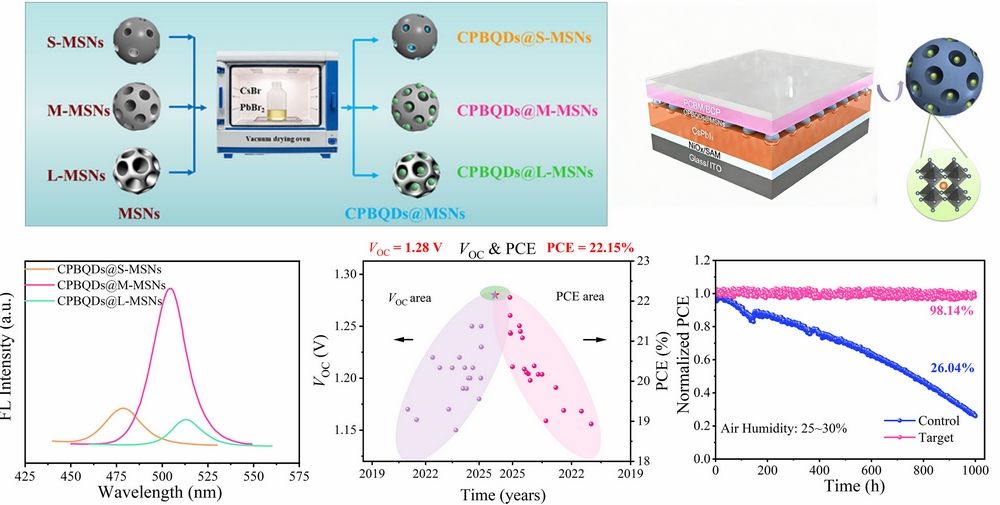
All-inorganic inverted CsPbI3 perovskite solar cells (PSCs) have attracted significant attention in the field of photovoltaics due to their excellent thermal stability, tunable bandgap, and high photoelectric conversion efficiency (PCE). However, the performance and stability of these devices are still severely limited by the intrinsic defects of the CsPbI3 perovskite films. On one hand, the high density of defect states at the film surface and at the grain boundaries act as non-radiative recombination centers, shortening the carrier lifetime and significantly reducing the open-circuit voltage (VOC) and fill factor (FF). On the other hand, due to the poor energy level matching between the perovskite layer and the charge transport layer, as well as the uneven interface electronic states, the charge extraction efficiency is often low.
To address these challenges, this work proposes an interface passivation strategy based on mesoporous silica (MSN) loaded with tunable-sized CsPbBr3 quantum dots (CPBQDs@MSNs). As shown in Figure 1, first, the reaction conditions were precisely controlled through a biphasic layered self-assembly method to prepare a series of MSNs with different particle sizes and pore diameters. Then, MSNs with different pore diameters were selected as nanoparticle templates, and in situ synthesized CPBQDs@MSNs composites with different sizes were prepared using the nano-confined synthesis strategy. The morphology and composition of the prepared quantum dot composites were thoroughly characterized, and the influence of quantum dot size on interface defect passivation, carrier dynamics, and device performance was systematically studied.
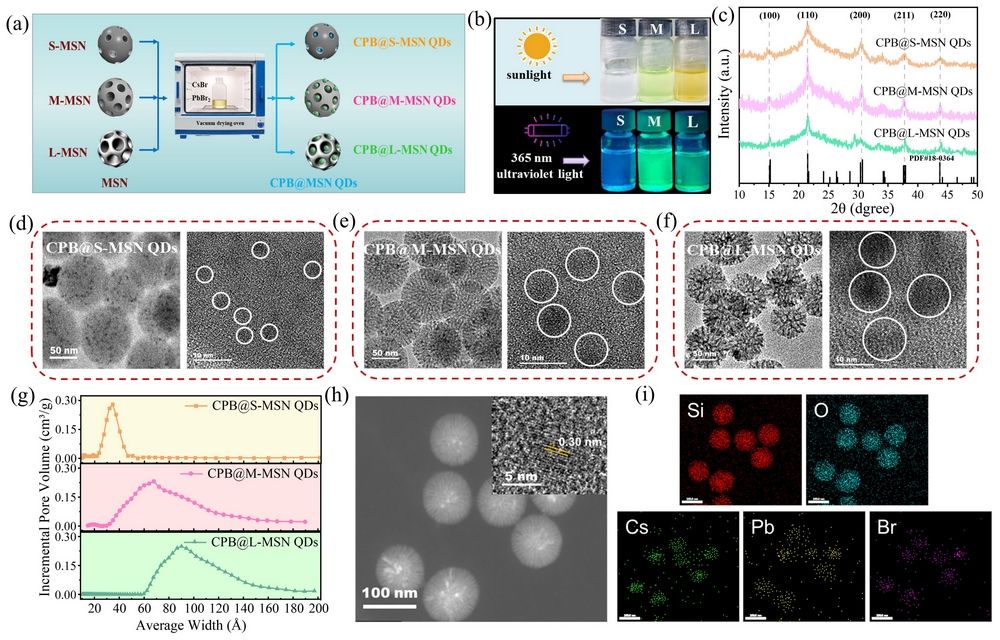
Figure 1. Preparation of quantum dots with different sizes via a nano-confinement strategy and their characterization
The research results indicate that when the pore size of CPBQDs@M-MSNs (approximately 8 nm) matches the exciton Bohr radius of CsPbBr3 (approximately 7 nm), the exciton-photon critical coupling effect can achieve uniform regulation of the interface electronic states, thereby significantly suppressing non-radiative recombination and the thermal activation process of defects. Moreover, CPBQDs@M-MSNs not only can fill the surface and grain boundary defects of the perovskite, improving the film density and flatness, but also can optimize the interface energy level matching, promote directional charge transport, and construct a moisture-proof SiO2 framework. The inverted CsPbI3 PSCs prepared based on this strategy achieved a PCE of 22.15%, which is the highest level reported for inverted CsPbI3 PSCs to date. Additionally, the device still maintained the initial PCE of 93.16% after being stored in air for 1300 hours, and still maintained an initial efficiency of 98.14% after continuous illumination for 1000 hours. This work provides a new idea and method for precisely regulating the surface properties of perovskites and achieving high efficiency and high stability of all-inorganic CsPbI3 perovskite solar cells.
First Authors: Xu dongfang and Cui Kaixiang, doctoral candidate, Shaanxi Normal University
Correspondence Authors: Prof. Liu Zhike and Prof. Ding Liping, Shaanxi Normal University
Full Text Link: https://advanced.onlinelibrary.wiley.com/doi/10.1002/adma.73024





 Latest Updates
 Hot Text Ranking