Yu Wang#, Yalei Ma#, Ruijuan Wen, Jing Li, Taihong Liu, Liping Ding, Rong Miao,* and Yu Fang. Chem. Sci., 2026, DOI:https://doi.org/10.1039/d6sc00753h
The precise manipulation of molecular excited states is a central goal in photophysics and photochemistry, as it ultimately dictates the performance of functional materials in applications such as organic light-emitting diodes (OLEDs), solar energy conversion, and optical sensing. Upon photoexcitation, molecules adopt unique electronic configurations that trigger distinct dynamical processes, including luminescence efficiency, reactivity, and photostability. Despite the extensive exploration of ground-state molecular libraries, the ability to predictively control excited-state dynamics remains limited. The development of efficient strategies to direct and modulate these pathways is therefore paramount, not only for fundamental understanding but also for the rational design of advanced optical materials.
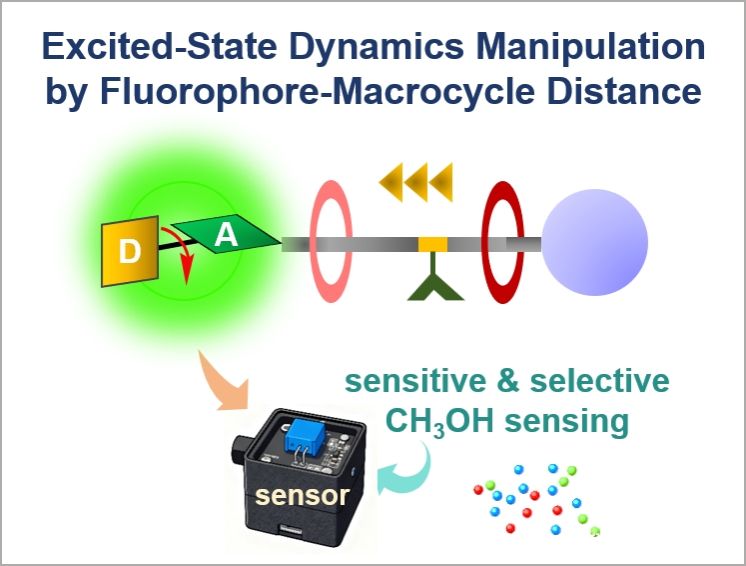
In this work, we present a supramolecular strategy utilizing mechanical interlocking to regulate photophysical pathways and molecular recognition. Three rotaxanes were synthesized by positioning a dibenzo-24-crown-8 macrocycle at specific sites along a naphthalimide-based axle. Femtosecond transient absorption spectroscopy revealed that the relaxation of excited-state is critically governed by the spatial separation: the closer the macrocycle to the fluorophore, the slower the twisted intramolecular charge transfer process. Single-crystal of the rotaxane showed a lamellar architecture, where the macrocycle acts as a pre-organized gatekeeper for the fluorophore. Therefore, highly sensitive and selective detection of methanol vapor is realized based on the rotaxane film. In addition, a portable sensor for reliable (< 0.099%vol), rapid (< 3 s), and reusable methanol detection in adulterated beverages is achieved. Our work establishes mechanical interlocking as a versatile approach to excited-state manipulating and sensor design.
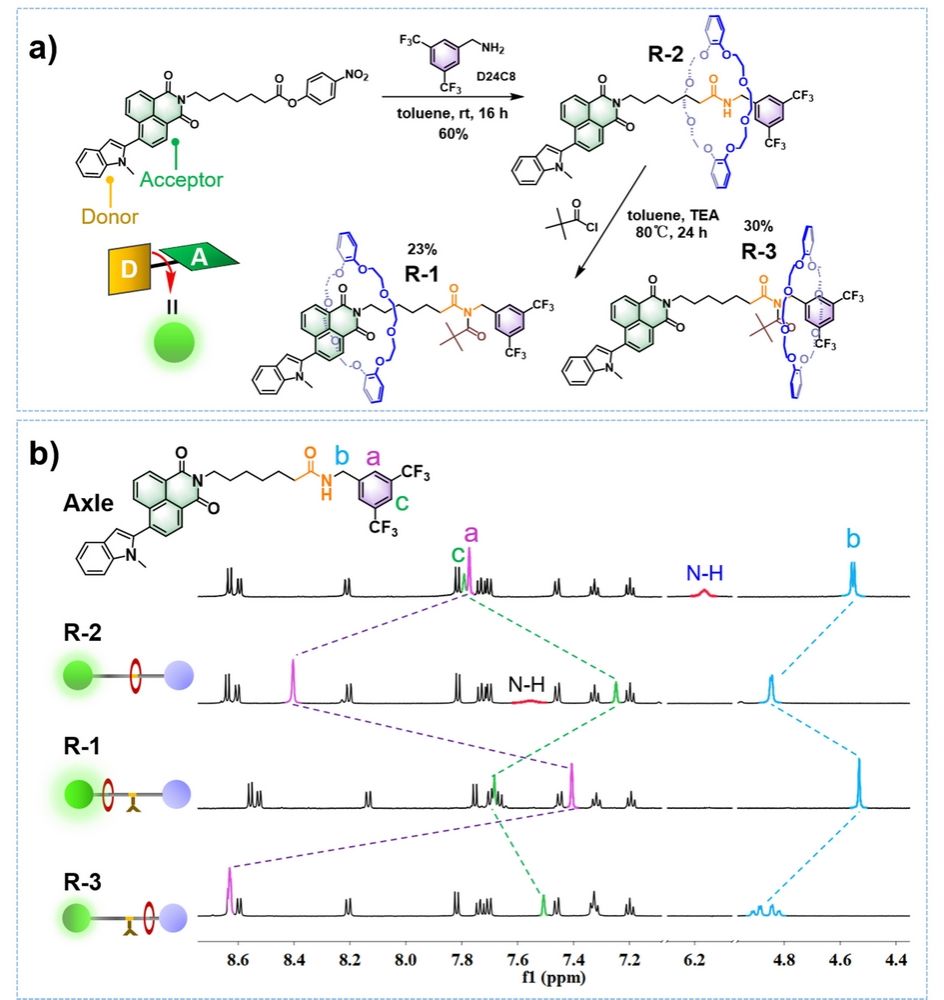
Figure1. (a) Synthesis route of the rotaxanes (R-1, R-2, and R-3). (b) Partial 1H NMR spectra of the naked axle, R-1, R-2, and R-3 in CD2Cl2.
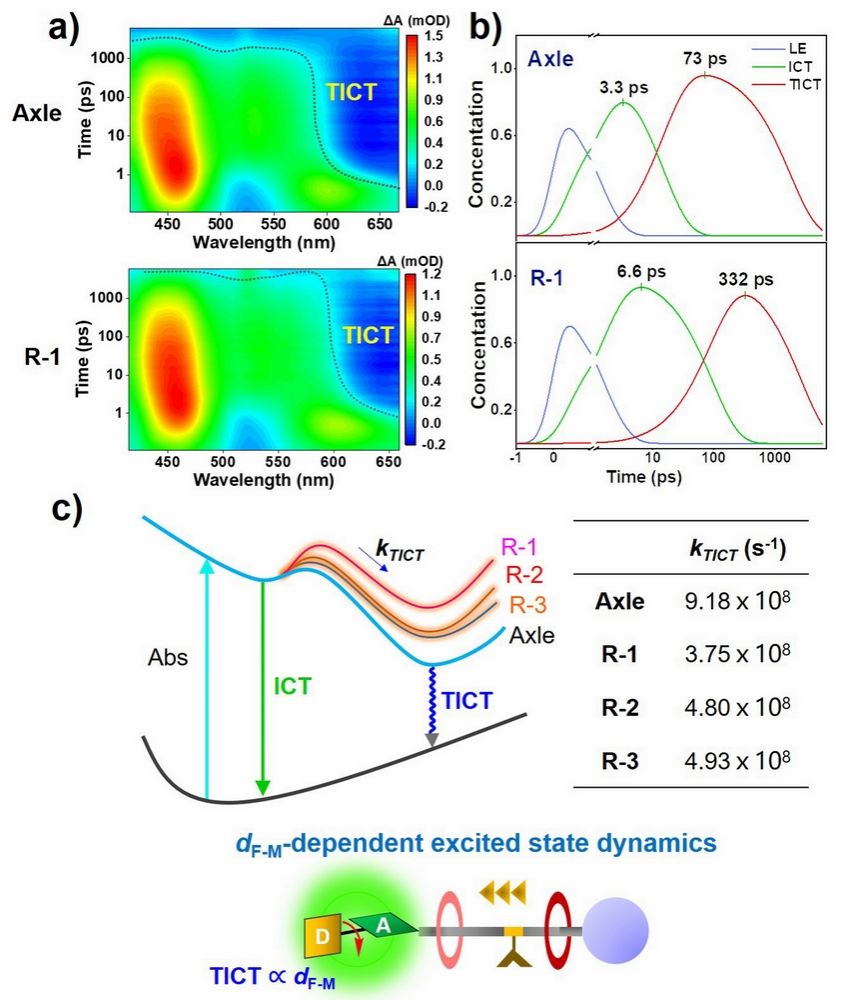
Figure2. (a) The fs-TA pseudo-color maps of the naked axle and R-1 in THF. Compound concentration: 5.0 × 10⁻⁵ M (b) The distribution of excited-state species (LE, ICT and TICT) in the naked axle and R-1 as a function of time. (c) Schematic illustration of excited-state relaxation pathways of the four compounds (Axle, R-1, R-2, and R-3), the formation rate constant of the TICT state, and the illustration of the supramolecular strategy for excited-state dynamics manipulation. Referring to the Marcus theory, 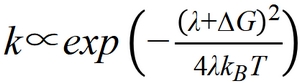 , where ∆G represents the change in reaction free energy.
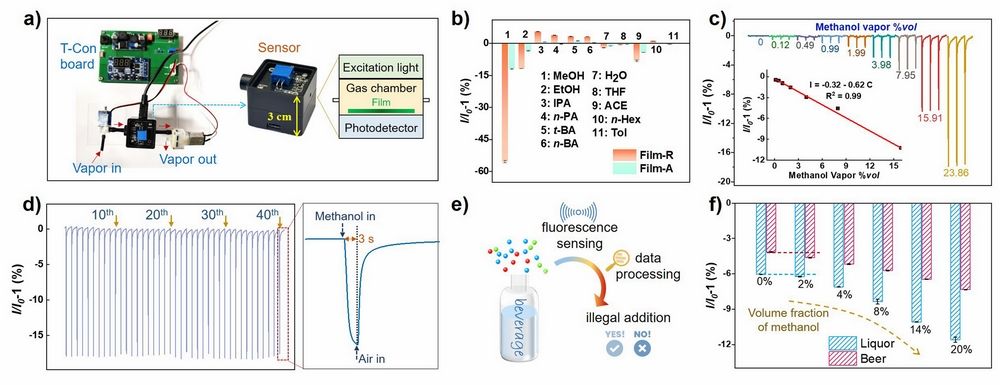
Figure3. (a) Photograph of the homemade sensing platform and the detailed layout of the portable sensor device. (b) Fluorescence responses of Film-R and Film-A to different types of volatile organic compounds and water. MeOH: Methanol; EtOH: Ethanol; IPA: Isopropyl alcohol; n-PA: n-Propanol; t-BA: tert-Butyl alcohol; n-BA: n-Butanol; THF: Tetrahydrofuran; ACE: Acetone; n-Hex: n-Hexane; Tol: Toluene (c) Responses of the Film-R sensor to vapors with varied methanol concentrations (0.12 ~ 23.86%Vol). The inset plots show the linear relationship between response intensity and methanol concentration. (d) Forty reversible sensing cycles of the Film-R sensor to methanol vapor. (24.24%Vol) (e) Schematic illustration of the identification of illegal methanol addition using the Film-R sensor. (f) Responses of the Film-R sensor to liquor (blue) and beer (red) added with different amounts of methanol.
First Authors: Wang Yu, master’s student, Ma Yalei, doctoral candidate, Shaanxi Normal University
Correspondence Author: Assoc. Prof. Miao Rong, Shaanxi Normal University
Full Text Link:https://doi.org/10.1039/d6sc00753h





 Latest Updates
 Hot Text Ranking