Yifan Su, Nađa Došlić, Manuel Martinović, Mladena Glavaš, Josip Draženović, Jiani Ma, and Nikola Basarić. J. Am. Chem. Soc. 2026, DOI: https://doi.org/10.1021/jacs.5c21621
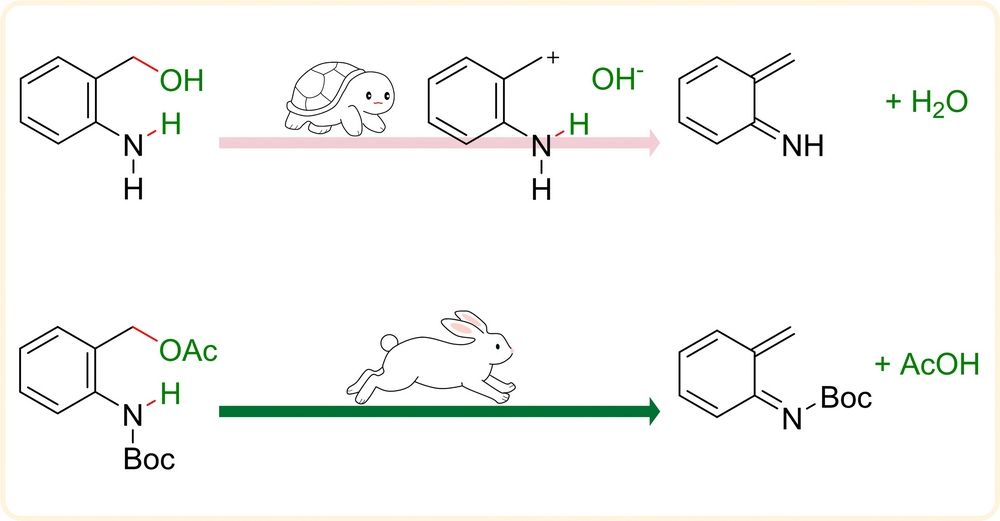
Quinone methides (QMs) are commonly encountered reactive intermediates in the chemistry and photochemistry of phenols. In the past decade, they have regained significant interest owing to their applications in organic synthesis. Aza-quinone methides (aza-QMs) are excellent precursors for the construction of aza-heterocycles. Nevertheless, the formation of aza-QMs often requires the breaking of aromaticity and proceeds under harsh conditions. The photochemical methods are much milder compared to the thermal since they rely on the use of only photons (no reagents), at ambient temperature, which can be accomplished with spatial and temporal control. Consequently, the photochemical generation of aza-QMs represents an attractive and promising strategy.
o-Hydroxymethylaniline (1) can undergo photodehydration to generate aza-QM. And the quantum yield of the photomethanolysis reaction is high (ΦR = 0.40). The photochemical formation of aza-QM from 1 was investigated by transient absorption spectroscopy and theoretical calculations, revealing a stepwise mechanism (Figure 1). Upon photoexcitation to the S₁(ππ*) state, 1 accesses the conical intersection between S₁(ππ*)/S₂(nσ*), leading to benzylic C–O bond cleavage. However, nonadiabatic population transfer between the ππ* and nσ* states may be inefficient, and the ππ* state exhibits an extended plateau after the conical intersection, resulting in a long-lived contact ion pair, as supported by experimental data. Subsequently, the excited-state contact ion pair returns to the ground state via a conical intersection, and undergoes deprotonation to sequentially generate a carbocation and aza-QM.
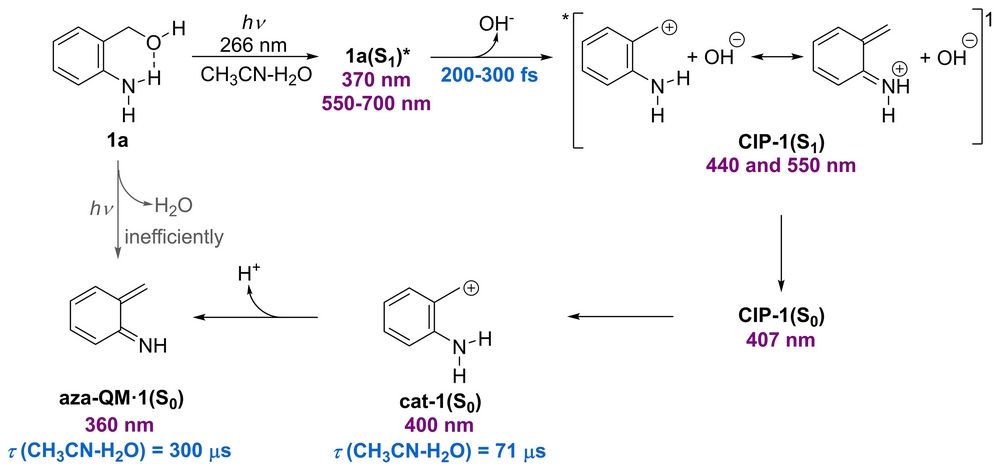
Figure 1. The H2O photoelimination mechanism from 1
To achieve more efficient photochemical generation of aza-QM, we designed N-Boc-O-Ac-aminobenzyl (5) by introducing an N-Boc group and an O-Ac onto 1 (Figure 2). The photomethanolysis of 5 is cleaner and more efficient, and quantum yield of the photomethanolysis reaction is comparable to that of 1 (ΦR = 0.49). The introduction of the Boc group not only increases the acidity of the NH group but also increases the number of reactive conformations available for elimination, facilitating the concerted elimination of AcOH. Furthermore, compared to the hydroxyl group, the acetyl group serves as a better leaving group. The acetyl group introduces a low-energy nπ* state, providing an additional pathway for ultrafast formation of aza-QM. There are two mechanisms for the cleavage of the C–O bond at the benzylic position. The first mechanism is similar to that of 1, involving a conical intersection between the initially excited ππ* state and the dissociating nσ* state. However, after passing through the S1(ππ*)/S2(nσ*) conical intersection, the steep rise in the energy of the ππ* state promotes more efficient C–O bond cleavage in 5. The second mechanism benefits from an additional nπ* state. Following photoexcitation to S1(ππ*), elongation of the benzylic C–O bond stabilizes the S3(nπ*) state, leading to population of S1(nπ*). The molecule accesses the nπ*/nσ* conical intersection, and the C–O bond cleaves. Upon reaching the nσ* state, the benzylic C–O bond breaks, rapidly generating aza-QM via the S1/S0 conical intersection. The photochemical generation of aza-QM from 5 is an ultrafast process occurring without detectable intermediates. The resulting aza-QM has a longer lifetime, enabling it to react with various nucleophiles and in relatively slow Diels–Alder reactions forming cycloadducts. This facilitates its application in organic synthesis and the construction of more complex aza-heterocycles.

Figure 2. The AcOH photoelimination mechanism from 5
This work not only provides guidance for the rational design of efficient aza-QM precursors, but also serves as a prerequisite for the application of aza-QMs in biological environments.
First Author: Su Yifan, doctoral candidate, Shaanxi Normal University
Correspondence Authors: Prof. Ma Jiani, Shaanxi Normal University; Prof. Nađa Došlić, Prof. Nikola Basarić, Ruđer Bošković Institute
Full Text Link: https://doi.org/10.1021/jacs.5c21621





 Latest Updates
 Hot Text Ranking