Pan Liu,† Xin Chen,† Chun Yang,† Helan Zhang, Liping Ding*, Ruijuan Wen, Haonan Peng*, Yu Fang. J. Mater. Chem. A: 2026, DOI: 10.1039/D6TA01728B
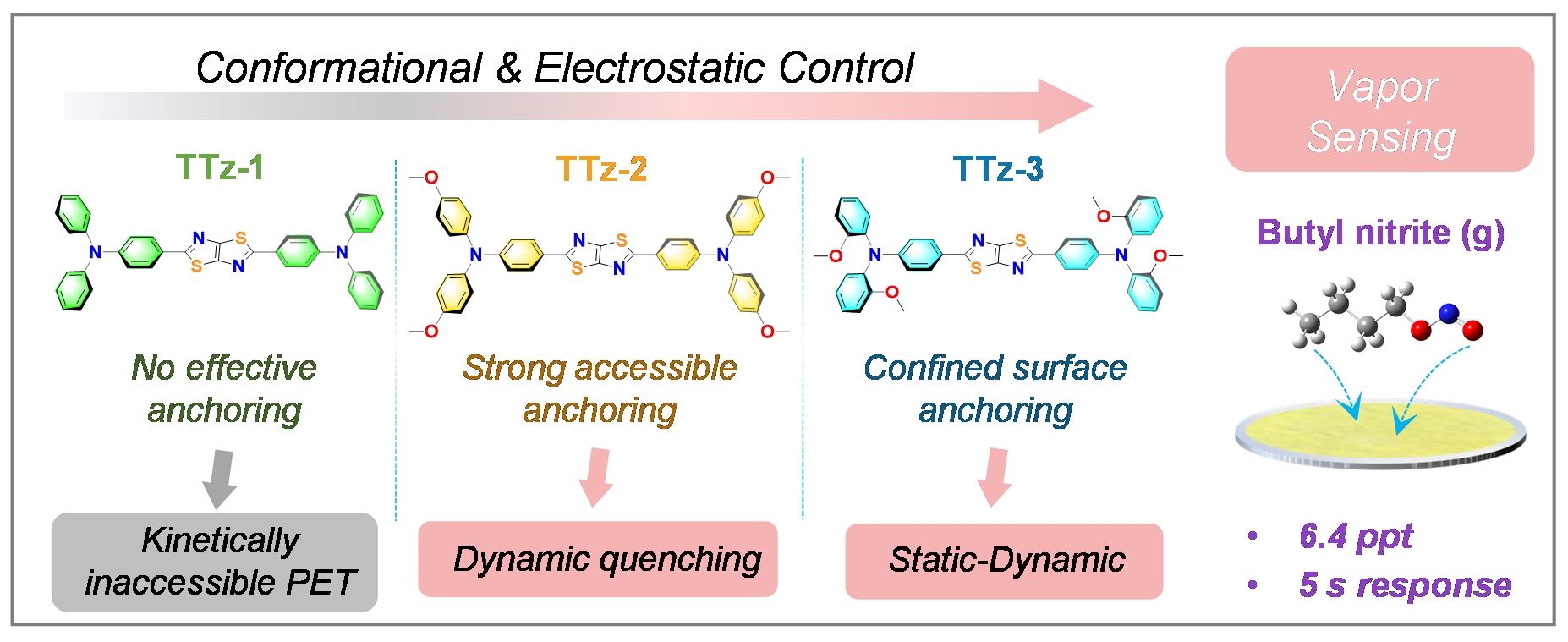
Butyl nitrite is a representative active component of volatile alkyl nitrite products such as “Rush Poppers”. Owing to its high volatility, rapid diffusion, and concealed use, its misuse may pose potential risks to public health and public safety. Therefore, developing rapid detection methods suitable for on-site monitoring is of great significance. Fluorescent film sensors, with the advantages of fast response, visual signal readout, and easy miniaturized integration, represent an important approach for the detection of volatile organic compounds.
Photoinduced electron transfer (PET) is an important signal transduction process in fluorescent sensing. For volatile molecules with electron-accepting ability, such as butyl nitrite, energy-level matching between the probe and the analyte provides the thermodynamic basis for PET quenching. However, the actual sensing response is not determined solely by whether the energy levels are suitable. Whether the analyte can approach the fluorophore, adopt an appropriate contact geometry, and maintain a sufficient interaction time all affect whether the PET process can occur efficiently. Therefore, regulating the kinetic accessibility of PET through molecular structure design is critical for achieving high-performance fluorescent sensing.
Based on this understanding, the research team constructed a TTz–TPA donor–acceptor–donor fluorescent molecular platform. TTz was used as a rigid electron-deficient acceptor, while TPA served as an electron donor with a tunable propeller-like conformation. By introducing methoxy substituents at different positions on the peripheral phenyl rings of TPA, the team systematically modulated the electron-density distribution, local electrostatic interaction sites, and spatial accessibility of the molecules, thereby controlling the approach mode of butyl nitrite to the fluorophore and the subsequent PET quenching pathway.
The study found that although unsubstituted TTz-1 is energetically capable of undergoing PET, it lacks effective local electrostatic interaction sites and therefore cannot form efficient close contact with butyl nitrite, resulting in almost no observable response. Para-methoxy-substituted TTz-2 enhances the local negative electrostatic potential on the molecular surface, allowing butyl nitrite to induce a fluorescence response mainly through dynamic PET quenching via transient encounters. In contrast, ortho-methoxy-substituted TTz-3, under the combined influence of stronger electrostatic interactions and conformational constraints, can form ground-state associates with butyl nitrite and exhibits a mixed PET quenching mechanism involving both static and dynamic processes.
Fluorescent films based on TTz-2 and TTz-3 both enabled rapid detection of butyl nitrite vapor, with a lowest detectable concentration of 6.4 ppt and a response time of approximately 5 s, while also showing good reversibility and cycling stability. This work advances fluorescent detection of volatile small molecules from conventional probe screening toward regulation of recognition kinetics, providing new insights for the design of high-performance fluorescent film sensors for alkyl nitrites, drug-related volatile substances, and other low-concentration hazardous vapors.
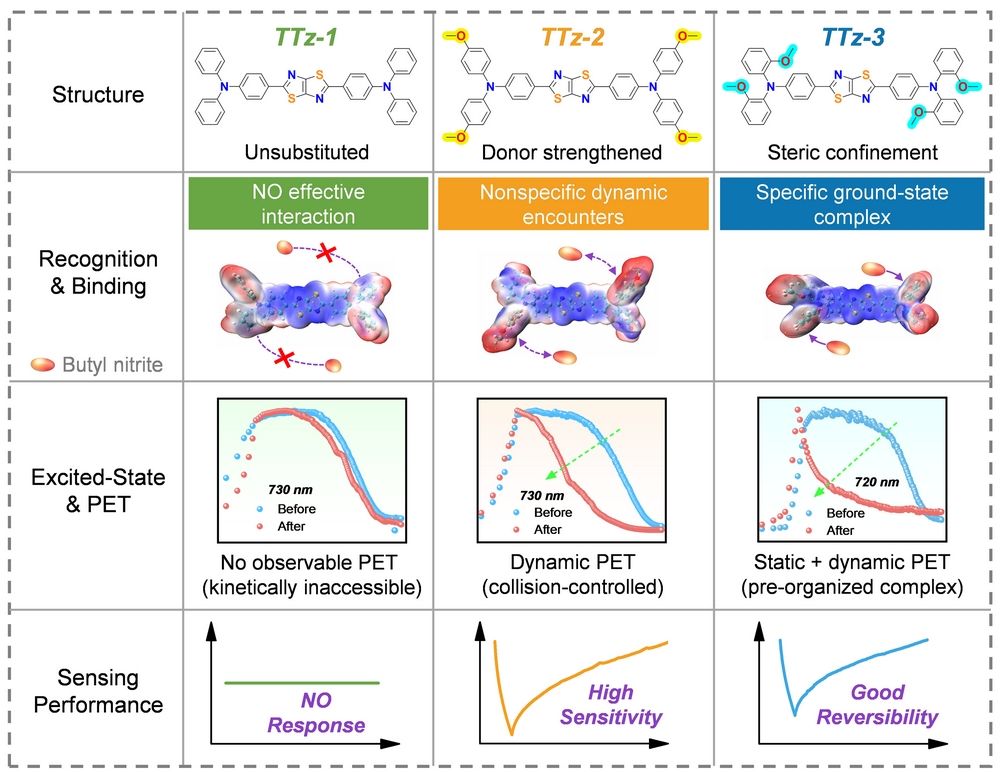
Figure 1. Conformational regulation of PET in TTz–TPA fluorophores for butyl nitrite sensing
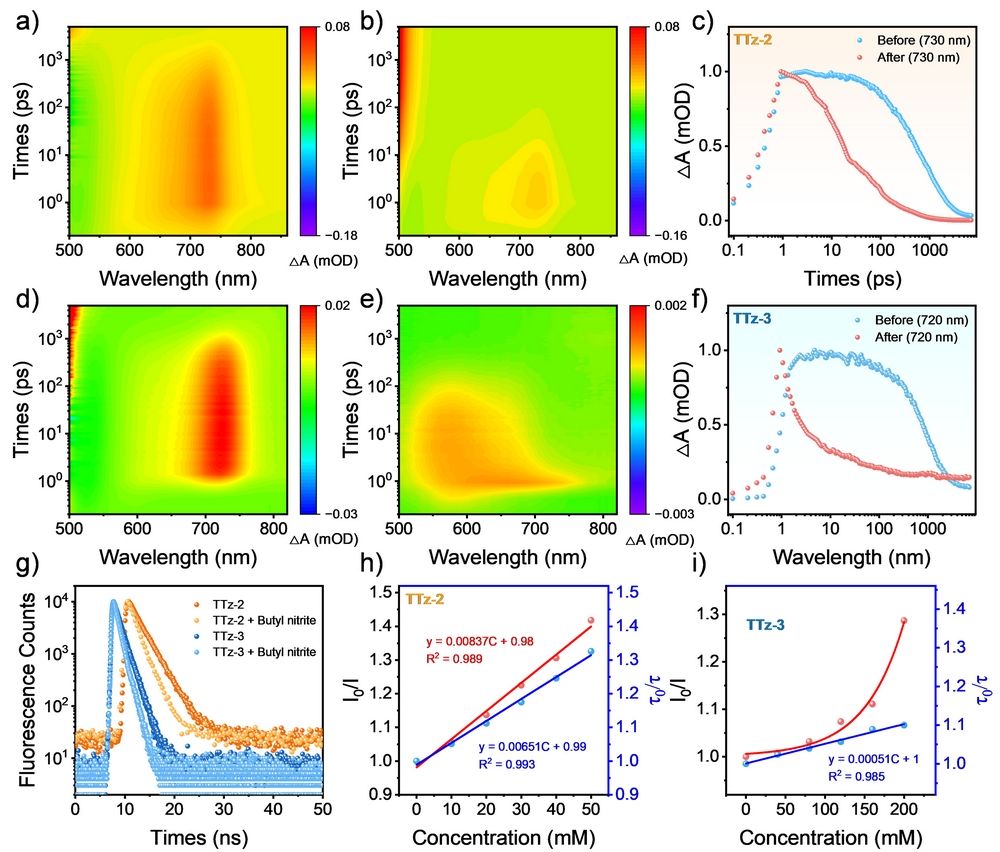
Figure 2. Excited-state dynamics and quenching analysis of TTz-2 and TTz-3 toward butyl nitrite
First Authors: Liu Pan and Chen Xin, master’s student, Yang Chun, doctoral candidate, Shaanxi Normal University
Correspondence Authors: Prof. Peng Haonan and Ding Liping, Shaanxi Normal University
Full Text Link: https://doi.org/10.1039/d6ta01728b





 Latest Updates
 Hot Text Ranking