Zhen Yan#, Yong Chen#, Yaqin Tian, Lizhi Zhang, Man Tian, Ruijuan Wen, Rong Miao, Taihong Liu*, Liping Ding*, Yu Fang. https://doi.org/10.1021/acssensors.6c00624
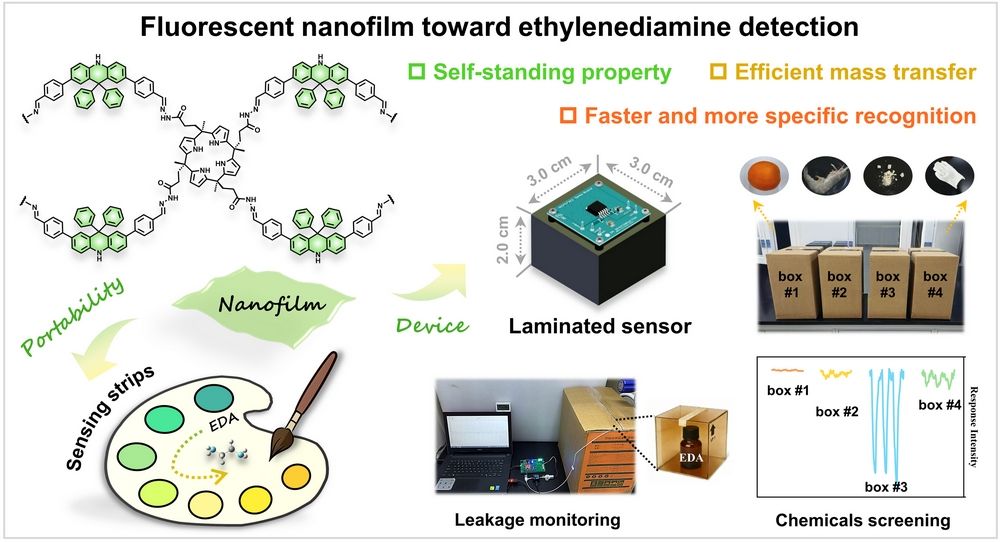
Ethylenediamine (EDA) has attracted considerable attention due to its importance in industrial applications and the associated potential safety risks. EDA exhibits strong corrosivity and systemic toxicity, capable of causing significant irritation and even irreversible damage to the skin and respiratory mucosa, as well as posing a high hazard to aquatic organisms. According to the World Health Organization (WHO) guidelines, concentration limits of EDA in industrial sites and environmental exposure is 10 ppm. Therefore, development of rapid and highly sensitive technologies for on-site monitoring EDA is of significant importance.
Herein, a flexible and uniform fluorescent nanofilm (denoted as ACC) was fabricated via an interfacial confined condensation strategy between an aldehyde-functionalized acridine fluorophore (ACR-2CHO) and a calix[4]pyrrole derivative (CPTH). Compared with the monomer ACR-2CHO, the nanofilm, owing to its unique network structure, achieves effective spatial isolation of fluorescent units, thereby significantly suppressing the ACQ effect. This nanofilm exhibits a ratiometric response toward EDA, accompanied by a distinct fluorescence color change from green to yellow-orange. By integrating the ACC nanofilm as an active sensing unit into a sensing platform, the resulting sensor exhibits excellent response and recovery performance toward EDA, with response and recovery times as low as 3.0 s and 3.5 s, respectively, a detection limit of 1.2 ppm, as well as good stability and repeatability. The sensor has been successfully applied for real-time detection of EDA in practical scenarios such as hazardous chemical screening and leakage detection. The research system, ranging from precise molecular design to functional device integration, provides an ideal fluorescent film material for real-time on-site EDA detection.
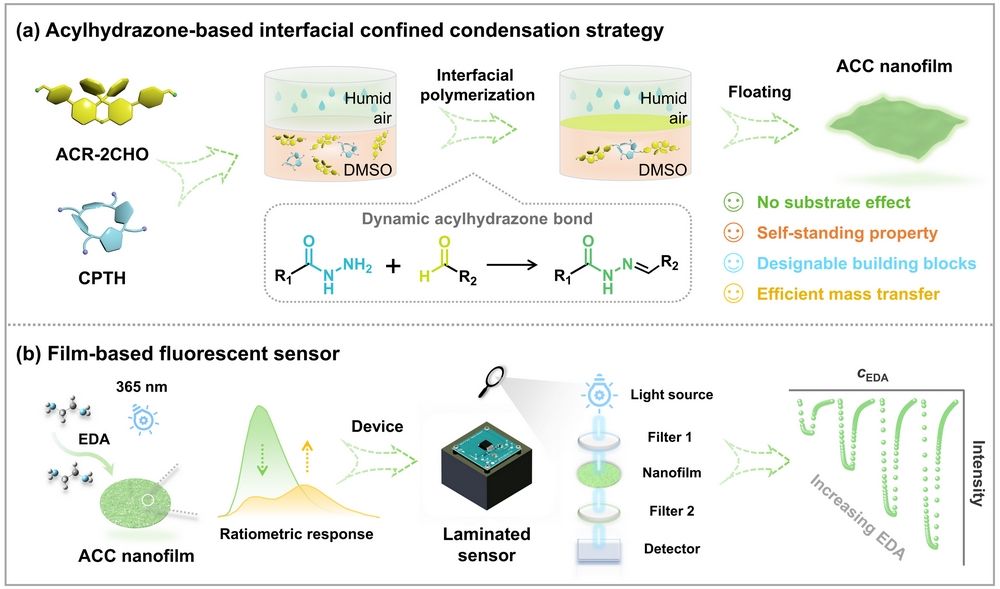
Fig. 1. (a) Schematic structures of the building blocks and representation of the nanofilm formation process through an interfacial confined condensation strategy; (b) Film-based fluorescent sensor using the ACC nanofilm as a key component for detecting EDA vapor
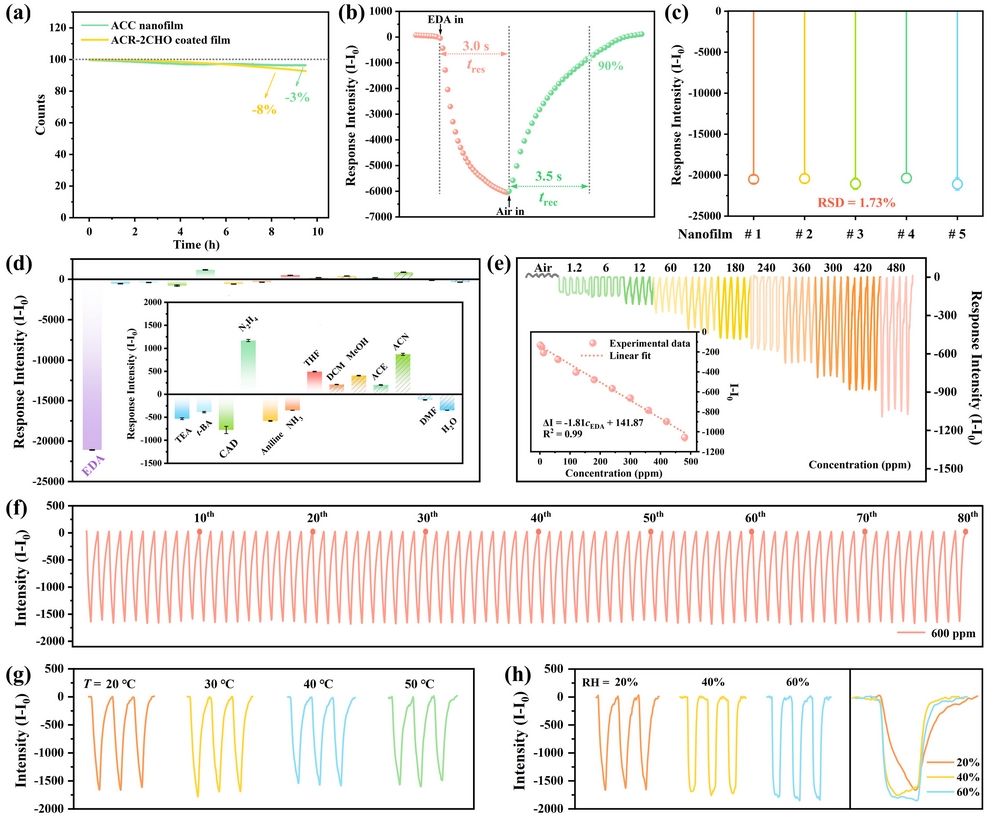
Fig. 2. (a) Photochemical stability of the ACC nanofilm monitored using the home-built sensing platform within 9 h continuous light irradiation (∼ 400 nm); (b) Response curve of the nanofilm to EDA; (c) Reproducibility evaluation using five independently prepared nanofilms; (d) Response comparison of the nanofilm-based sensor upon exposure to saturated EDA and some potential interferences, where each measurement was repeated at least three times; (e) Sensor responses to different concentrations of EDA vapor, insets: the relationship between the response intensity and EDA concentration; (f) Repeatability test showing stable cycling performance over 80 exposure-recovery cycles; (g) Response of ACC nanofilm to EDA vapor at different environmental temperatures; (h) Response of ACC nanofilm to EDA vapor at different humidity, and the right curves show the kinetic comparison at different humidity.
First Authors: Yan Zhen and Chen Yong, doctoral candidate, Shaanxi Normal University
Correspondence Authors: Prof. Ding Liping and Prof. Liu Taihong, Shaanxi Normal University
Full Text Link: https://doi.org/10.1021/acssensors.6c00624





 Latest Updates
 Hot Text Ranking