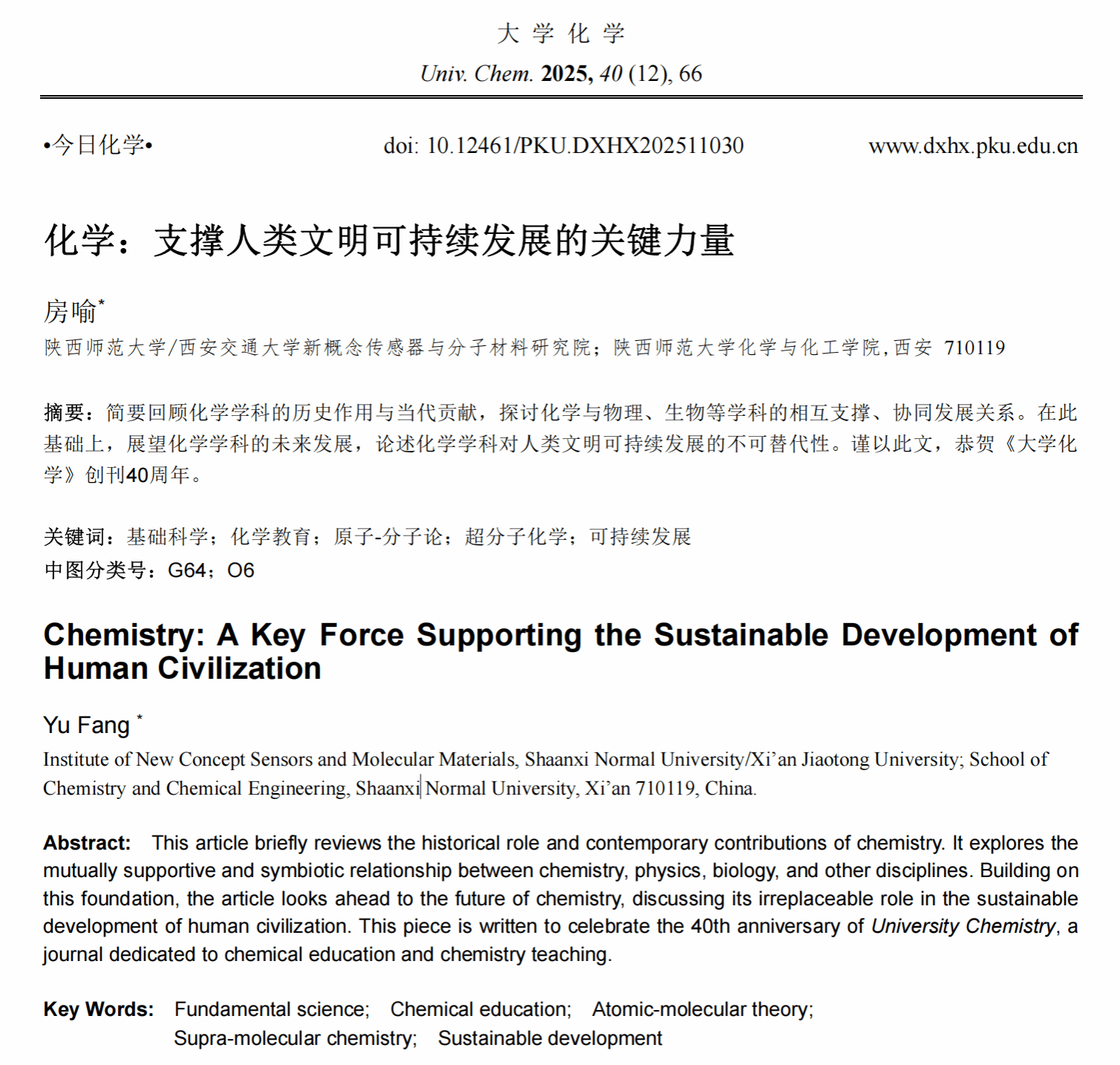
The United Nations General Assembly designated 2022 as the “International Year of Basic Sciences for Sustainable Development” and adopted the resolution on the United Nations Decade of Science for Sustainable Development (2024–2033) in August 2023, underscoring the international community's broad consensus on the pivotal role of basic sciences in advancing sustainable development for human civilization. As a fundamental discipline studying the creation of matter and transformation of energy, chemistry serves not only as a core tool for revealing natural laws but also as a vital driving force for reshaping the world and shaping the future. Together with physics, biology, and other disciplines, chemistry forms the scientific foundation for humanity's exploration and transformation of nature to enhance well-being. The depth and breadth of its development directly impact humanity's capacity to address future challenges and achieve sustainable development.
1 The Origin and Development of Chemistry
The discipline of chemistry has evolved into a fundamental branch of science with a rigorous theoretical framework and mature methodological systems, driven by humanity's long-term exploration and particularly by systematic research over the past few centuries. From Lavoisier's establishment of the law of conservation of mass, which initiated quantitative chemical research, to Dalton's atomic theory, and further to Cannizzaro's refinement of the atomic-molecular theory, chemistry gradually established the fundamental conceptual framework: “Matter is composed of atoms; atoms combine to form molecules; and the structure of molecules and their aggregated states determines the properties of matter.” Once established, this framework became the theoretical cornerstone of chemistry, remaining unchallenged for centuries.
However, the advancement of chemistry has never ceased. The Nobel Prizes in Chemistry awarded in 1987, 2016, and 2025 recognized pioneers in supramolecular chemistry, molecular machines, and framework chemistry, respectively. This signifies that chemical research is expanding beyond the traditional realm of strong covalent bonding interactions into a new phase characterized by intermolecular weak interactions, dynamic bonding, multilevel assembly, and structural regulation—the era of “supramolecular chemistry” and even “adaptive chemistry.” In this process, chemists' methods for creating new substances are no longer confined to traditional “synthesis,” with “assembly” playing an increasingly prominent role in material construction. In recent years, research on structural innovation driven by artificial intelligence and rational design for functional applications has garnered increasing attention. In 2022, the team led by Luo Yi and Jiang Jun at the University of Science and Technology of China introduced an all-in-one AI chemist capable of autonomously retrieving literature from cloud databases, proposing experimental protocols based on this information, and then controlling mobile robots in the lab or online to execute the entire experimental process—including synthesis, characterization, and performance testing. In 2024, Google DeepMind's latest version of AlphaFold achieved precise simulations of protein interactions with other molecules. These efforts undoubtedly hold immense potential to advance chemical research and accelerate new drug discovery. It can be said that the field of chemistry has entered a new era of intelligent chemistry, a fact underscored by the 2024 Nobel Prize in Chemistry being awarded to artificial intelligence researchers.
Meanwhile, the scope of chemical research subjects continues to expand. Chemical measurement has evolved from qualitative and quantitative analysis of material composition to include spectral analysis of molecular and aggregate structures, diffraction characterization, visualization techniques, and even measurements of physical properties, structures, and reactivity at the single-molecule and single-particle levels. Dynamic processes, excited-state behavior, soft matter interfaces, molecular devices, and innovations in theoretical and experimental methods are emerging as new frontiers in chemical research. The cognitive boundaries of chemistry continue to expand, with significant enhancements in the discipline's capabilities. In the realm of material innovation, chemistry has achieved a transformative leap: from “synthesis” to “synthesis + assembly,” then to “rational design → (synthesis + assembly),” and finally to “artificial intelligence → rational design → (synthesis + assembly).”
2. The Integration of Chemistry with Physics and Biology
The development of chemistry has always been interdependent and co-evolved with related disciplines. Its deep integration with physics is particularly evident: physical methods such as X-ray diffraction, spectroscopy, time-resolved techniques, and imaging enable chemists to visually analyze molecular structures, reaction dynamics, and excited-state processes; quantum mechanics and statistical mechanics laid the foundation for the establishment and advancement of theoretical chemistry. Conversely, chemistry's continuous breakthroughs in creating novel materials—such as semiconductors, low-dimensional materials, assembled materials, gradient materials, and metamaterials—have provided physical carriers for physics to explore new phenomena and formulate new laws, directly propelling industrial technological advancement.
The interaction between chemistry and biology is equally profound. The atomic-molecular theory established by chemists propelled biological research from the cellular level to the molecular level. The revelation of the DNA double helix structure is, at its core, a concrete manifestation of chemical bonds and stereochemical principles within living systems. The advancement of chemistry gave rise to biochemistry and chemical biology. Meanwhile, life sciences' elucidation of mechanisms such as self-replication, self-repair, self-regulation, and external field perception has inspired chemists to design adaptive molecular systems with “life-like” characteristics. This has propelled chemistry from preparing passive “responsive materials” to creating active “interactive materials.”
As Huawei founder Ren Zhengfei has pointed out, chip manufacturing relies not only on design capabilities but also on the level of foundational industries such as manufacturing equipment and chemical reagents. This profoundly illustrates that a robust chemical discipline is the bedrock for the development of cutting-edge technology industries. Chemistry bridges the microscopic and macroscopic worlds, serving as the connecting thread between inanimate and living systems. It has become the cornerstone for understanding fundamental transformations—from atoms to matter, from cells to life, and from life to consciousness. It is foreseeable that chemistry will play a pivotal role in solving century-old challenges: unraveling the origins of life, deciphering brain cognition, exploring the essence of consciousness, integrating carbon-based life with silicon-based intelligence, synthesizing life, creating “impossible substances,” and achieving artificial photosynthesis.
3 Chemistry and Human Sustainable Development
The mission of chemistry has always been inextricably linked to human survival and development. Against the backdrop of population growth, climate change, resource scarcity, and mounting environmental pressures, chemistry—as a foundational and driving discipline—is playing an increasingly vital role.
Chemistry plays an indispensable role in ensuring global food security. In terms of boosting food production, its contributions are both tangible and profound: modern agricultural productivity relies heavily on the support of the chemical industry. Statistics indicate that approximately one-third of the world's food production is directly attributable to the use of chemical fertilizers. Simultaneously, chemical pesticides significantly reduce pre- and post-harvest crop losses by effectively controlling pests, diseases, and weeds. Taking China as an example, the scientific application of pesticides can prevent tens of millions of tons of grain losses annually—roughly equivalent to Henan Province's total annual grain output—making it of profound and far-reaching significance for safeguarding the nation's food supply. The role of chemistry extends beyond merely “increasing production” to “reducing losses.” From growth regulators that enhance crop stress resistance to fumigants and protective agents that prevent mold and insect infestation in stored grain, chemical technologies span the entire “farm-to-table” chain, minimizing grain losses to the greatest extent possible. Moreover, chemical measurement technologies have established a rigorous agricultural product safety monitoring network, enabling precise control over risks such as pesticide residues and heavy metal contamination. This approach safeguards both yield and quality while ensuring food safety. Indeed, chemistry plays multiple irreplaceable roles in building global and national food security systems.
In the realm of human health, chemistry also plays a pivotal role. The discovery and application of artemisinin—a drug derived from traditional Chinese medicine through chemical extraction, modification, and validation—has saved hundreds of millions worldwide from malaria, exemplifying how chemistry and life sciences intersect to serve human health. Advances in synthetic chemistry, medicinal chemistry, and chemical measurement technologies continue to propel the modern pharmaceutical industry in developing antibiotics, vaccines, targeted drugs, and innovative therapies, providing increasingly precise drug options to address diverse diseases. Chemistry also builds defenses across multiple levels of disease prevention, diagnosis, and health management: At the prevention level, chemical disinfection and nutritional fortification technologies reduce the risk of infectious disease transmission; at the diagnosis level, techniques such as immunoassays, molecular probes, and medical imaging provide core tools for early and precise diagnosis. Furthermore, innovations in pharmaceutical formulation, medical materials, and nutritional assessment are driving the establishment of a comprehensive health security system.
Chemistry plays a central role in advancing the green transformation of energy systems. In addressing climate change challenges, chemists pursue breakthroughs on both fronts of “expanding sources” and “conserving resources”: On the “expanding sources” front, the photoelectric conversion efficiency of novel photovoltaic technologies like crystalline silicon cells and perovskite solar cells continues to be redefined through chemical material innovations, laying the foundation for low-cost, high-efficiency capture of solar energy; In “conserving resources” and energy storage, the deepening application of chemical principles is driving continuous improvements in battery energy density and cycle life. Electrocatalytic or photocatalytic water-splitting technologies for producing “green hydrogen” offer a viable pathway for converting intermittent renewable energy into storable chemical energy. These technological advancements stem from chemists' profound understanding of the relationship between material structure and properties. Through molecular design, interfacial control, and reaction engineering, they create functional materials, uncover the microscopic mechanisms of energy conversion, and ultimately achieve optimized energy efficiency. Fundamental innovations in chemistry provide the scientific and technological foundation for realizing the dual carbon goals and constructing new energy systems.
4. Transformation and Vision in the Chemistry Discipline
Chemical science research is undergoing a profound paradigm shift. Its focus has expanded beyond innovations in molecular-scale structures, synthetic methods, and assembly techniques, or the mere pursuit of multifunctional materials. Instead, it is increasingly directed toward achieving precise understanding, reliable prediction, and active control of molecular structures, molecular behavior, reaction pathways, and system properties within complex, multilevel, and multiscale systems. This transformation relies not only on a profound understanding of intermolecular interactions and reaction mechanisms, but also requires the integration of advanced characterization techniques, theoretical simulations, data science, and artificial intelligence. This enables high spatiotemporal resolution manipulation of chemical processes at the mesoscopic and even macroscopic scales. It signifies a leap in chemical research from “uncovering and understanding principles” to “on-demand design and rational regulation,” providing more precise and intelligent solutions for critical fields such as energy, healthcare, environment, and materials. At the same time, this places higher demands on contemporary chemists: they must build interdisciplinary knowledge structures and innovative capabilities to become versatile professionals capable of conducting innovative research across disciplines, solving real-world problems, and meeting genuine needs—that is, the “interdisciplinary innovators” sought by industry.
In the foreseeable future, the discipline of chemistry must advance atom-economical reactions and green synthetic pathways to mitigate environmental pressures at the source during material creation and energy conversion processes. It must leverage artificial intelligence and big data technologies to achieve automation and intelligence in the precise design, synthesis, and assembly of new molecules and materials. Furthermore, it must develop “intelligent material” systems capable of sensing, computing, responding, and even self-repairing—transcending nature while drawing inspiration from it. By underpinning the advancement of future technologies—including quantum science, synthetic biology, space exploration, human augmentation, millimeter-wave communication, and terahertz detection—chemistry will better serve national strategic needs, support the sustainable development of human civilization, and demonstrate its irreplaceable value.
The Tao Te Ching states: “At the beginning of all things, the Great Way is simple; through evolution, it becomes complex.” The development of chemistry vividly embodies this philosophical insight. Starting from fundamental units like atoms and molecules, chemistry has progressively constructed a material world of infinitely rich structures and functions. This cognitive journey not only endows humanity with the ability to understand and transform the material world but also shapes chemists' rigorous, pragmatic thinking habits and meticulous approach to work—truly “contemplating the minute and acting with precision.” Chemistry serves as the cornerstone of the scientific system due to its foundational nature. Its pervasive influence integrates it into numerous scientific and technological fields. Its applied nature continuously drives technological innovation. And its constant evolution ensures its enduring vitality. These characteristics collectively forge chemistry's distinctive character as a discipline that “reaches the heavens and grounds itself in the earth.”
Chemistry has never been an isolated island. It serves as a vital bridge between fundamental science and engineering technology, between inanimate and living matter, and stands as the core pillar supporting the advancement of nearly all scientific and technological fields—including materials, energy, environment, life sciences, and information technology. Since its emergence as a systematic discipline, chemistry has consistently and quietly propelled the progress of human civilization. It can be said that chemistry plays an irreplaceable foundational role in national modernization, national rejuvenation, and the sustainable development of human civilization. Admittedly, chemistry cannot solve every problem. Yet without it, none of modern civilization's achievements would exist. Chemistry is the future. Without it, the sustainable tomorrow we envision would lose its very foundation.
5 Conclusion
Looking back at history, practice has delivered a fair verdict: any stigmatization or one-sided criticism of chemistry is a short-sighted act lacking foresight. It is chemistry that has repeatedly rescued humanity from famine and disease, laying a solid material foundation for the functioning of modern society. Looking ahead, from achieving the grand goal of carbon neutrality to building a zero-waste future where everything recycles, we need chemistry—and the chemists diligently working in laboratories—more than ever before. Their explorations concern not only the future of our planet but also the sustainable tomorrow shared by all humanity.
For this reason, we must pay tribute to University Chemistry, honoring its decades of unwavering dedication to restoring chemistry's reputation and championing the reform and advancement of chemistry education.
This article was published in University Chemistry, Issue 12, 2025:
Yu Fang. Chemistry: A Key Force Supporting the Sustainable Development of Human Civilization[J]. University Chemistry, 2025, 40(12): 66-69.



 Latest Updates

 Hot Text Ranking