Yibo Zhao, Shufei Li, Xingtong Zhou, Taihong Liu*, Liping Ding, and Yu Fang. J. Phys. Chem. B, 2026, DOI: https://doi.org/10.1021/acs.jpcb.6c02968
*Published as part of The Journal of Physical Chemistry B special issue “Yu Fang Festschrift”.
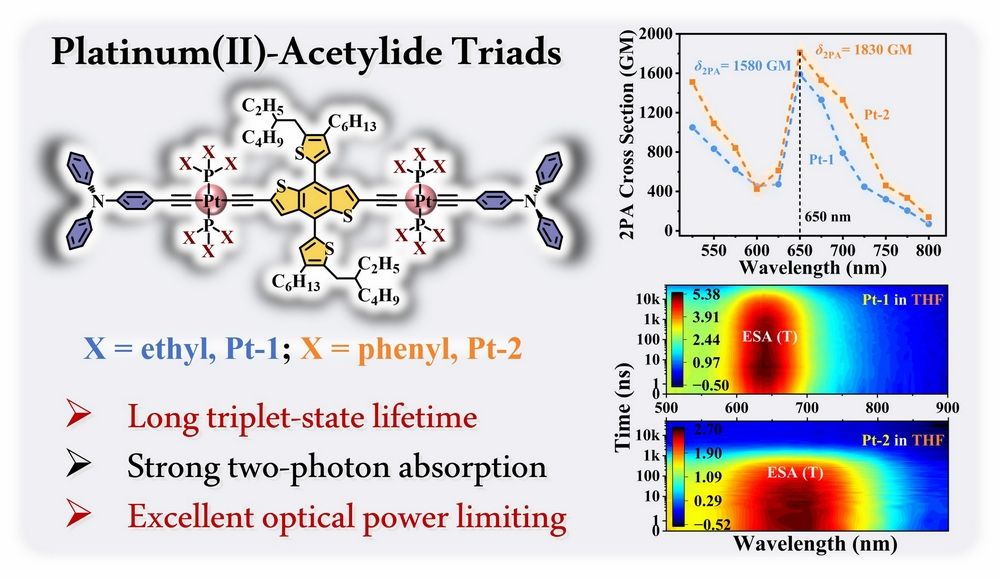
Unveiling the intramolecular photophysical transitions and intrinsic excited-state dynamics of organometallic complexes is of critical importance yet remains challenging. Herein, two platinum(II)-acetylide triads, namely Pt-1 bearing the triethylphosphine ligands and Pt-2 with the triphenylphosphine ligands, were rationally synthesized and investigated comprehensively. The NMR shielding phenomena of Pt(II) atoms with dense extranuclear electron are elucidated properly through comparative studies on a reference analogue BDT-TPA. The rigid planar molecular geometries endow the triads with extended π-conjugation, which promotes efficient ligand-to-metal charge transfer (LMCT) and ligand-to-ligand charge transfer (LLCT). Furthermore, significant effect of Pt(II)-acetylide d-p coordination, ligand aromaticity, and steric hindrance on the steady-state and nonlinear optical properties are also elucidated comparatively. Benefiting from strong spin-orbit coupling and ligand-mediated conjugation, both Pt(II)-acetylide triads exhibit enhanced intersystem crossing rates and prolonged triplet-state lifetimes. Notably, Pt-2 displays a maximum two-photon absorption cross-section of 1830 GM in THF upon femtosecond excitation at 650 nm, which is obviously higher than that of 980 GM at 775 nm observed for BDT-TPA. High-performance optical power limiting assessments based on the two-photon absorption mechanism reveal that both triads possess low onset thresholds around 0.06 J×cm-2 and favorable limiting thresholds around 0.25 J×cm-2. Theoretical calculations further correlate the superior nonlinear optical performance with efficient excited-state absorption as well as prominent LMCT characteristics. This study not only affords mechanistic insights into the intrinsic photophysics of the Pt(II)-acetylide complexes but also sheds light on the potential nonlinear optical applications.
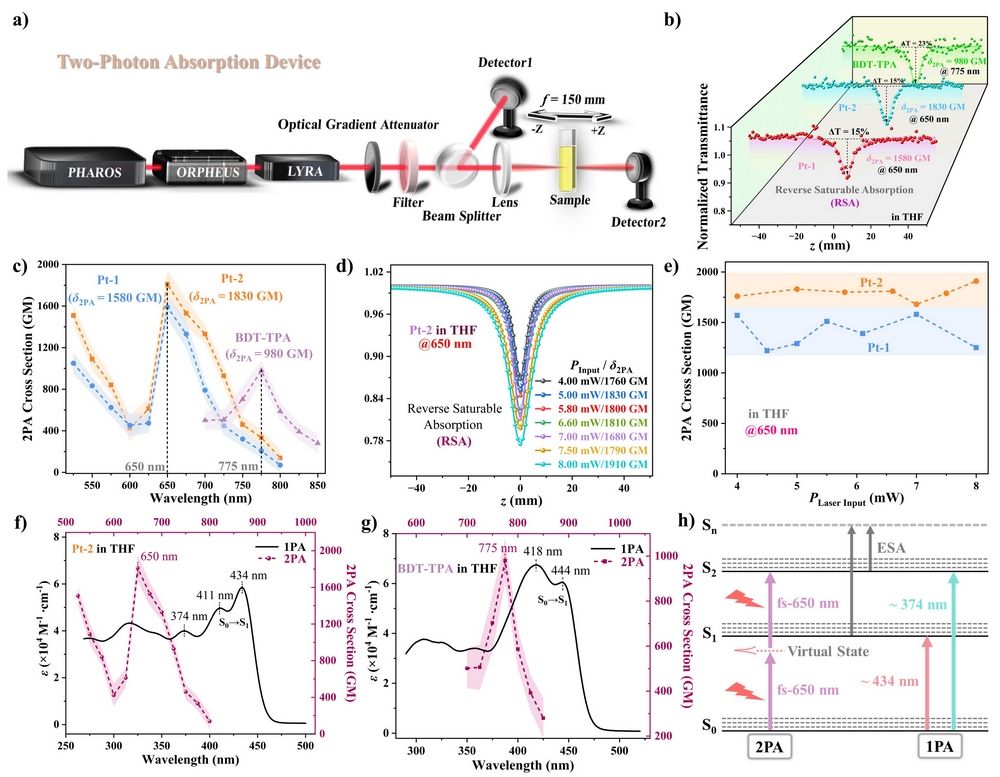
Figure 1. Two-photon absorption data of the triads Pt-1, Pt-2, and the reference analogue BDT-TPA
First Author: Zhao Yibo, master’s student, Shaanxi Normal University
Correspondence Author: Prof. Liu Taihong, Shaanxi Normal University
Full Text Link: https://doi.org/10.1021/acs.jpcb.6c02968





 Latest Updates
 Hot Text Ranking