Yaqin Tian#, Zhen Yan#, Yong Chen, Lizhi Zhang, Ruijuan Wen, Xiaolin Zhu*, Liping Ding*, Yu Fang. https://doi.org/10.1021/acsami.6c05572
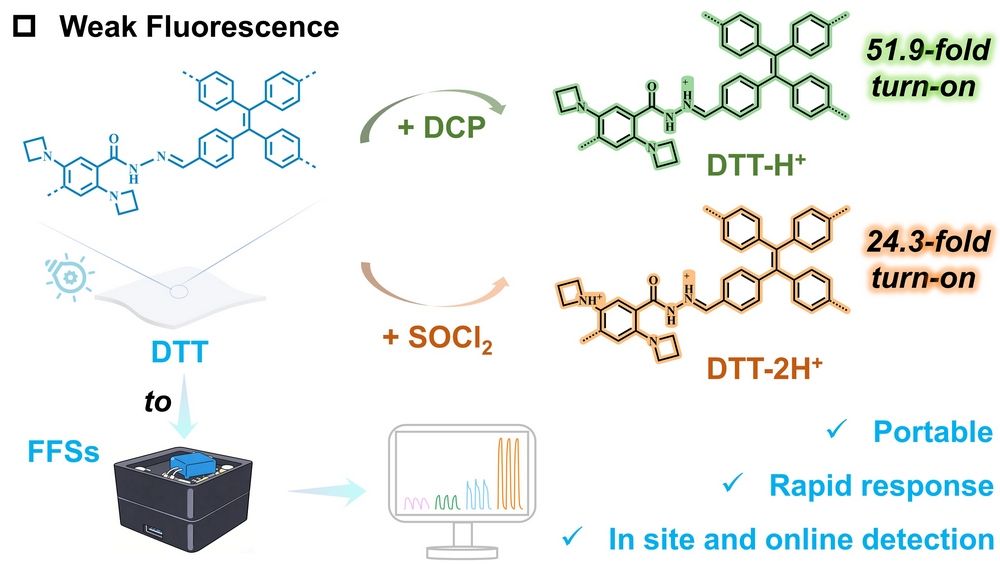
Diethyl chlorophosphate (DCP) and thionyl chloride (SOCl2) are important organic synthetic intermediates that are widely used in pharmaceuticals, pesticides, dyes, and polymers. However, these chemicals are also highly toxic, volatile substances that pose significant risks to public safety and human health. Therefore, the development of rapid, sensitive, and on-site detection methods for these hazardous vapors is of great importance for environmental safety and public health.
Herein, we designed and synthesized an azetidinone-functionalized hydrazide derivative (DATH) and employed a tetraphenylethylene-based aldehyde (TFPE) as the complementary building block. Through an air/DMSO interfacial confined self-assembly strategy, we prepared a free-standing, smooth nanofilm featuring tunable thickness and size as well as excellent substrate adaptability. The prepared nanofilm is initially nonfluorescent but displays pronounced fluorescence enhancement accompanied by distinct emission color changes upon exposure to DCP and SOCl2 vapors. By integration of the nanofilm into a lab-built sensing platform, real-time and online monitoring of DCP and SOCl2 was successfully realized. The sensor exhibits a fast response time within 3.0 s, detection limits of 0.52 ppm for DCP and 1.31 ppt for SOCl2, and excellent repeatability over 40 cycles. Selective detection of DCP and SOCl2 can be realized according to their different response kinetics from common interferents such as trifluoroacetic acid (TFA) and hydrochloric acid (HCl). These results underscore the great potential of interfacial-assembled fluorescent nanofilms as a versatile material platform for rapid and discriminative detection of highly hazardous vapors, offering promising applications for environmental safety monitoring and early warning applications.
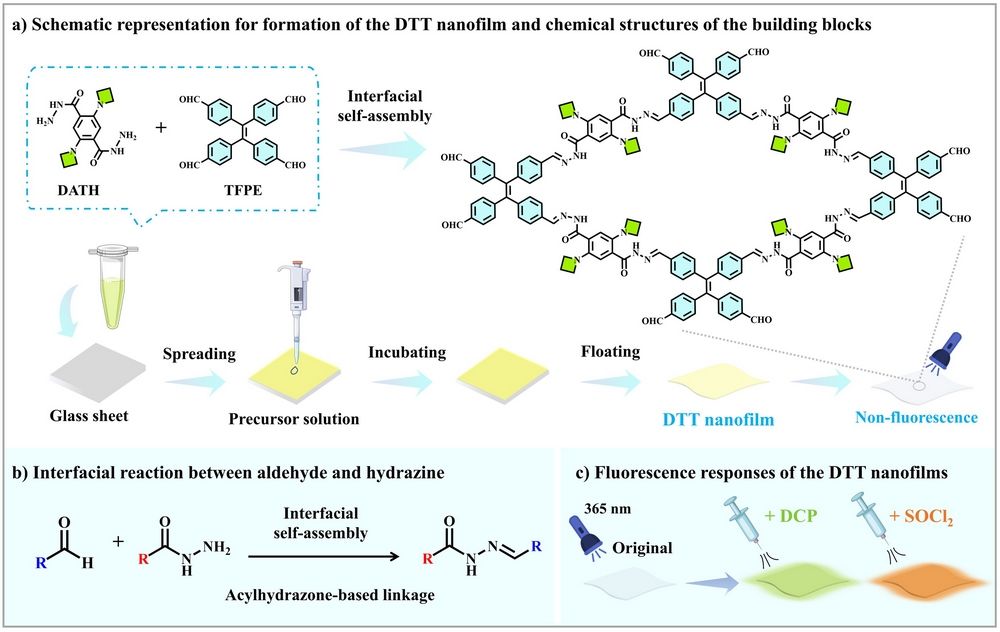
Fig. 1. (a) Chemical structures of the azetidinone hydrazide derivative (DATH) and tetraphenylethylene-based aldehyde (TFPE), and the schematic of formation process of the DTT nanofilm at the humid air/DMSO interface; (b) Dynamic covalent acylhydrazone condensation involved in the nanofilm formation process; (c) Schematic illustration of the visually differentiated fluorescence responses of DTT nanofilm toward DCP and SOCl2 vapors.
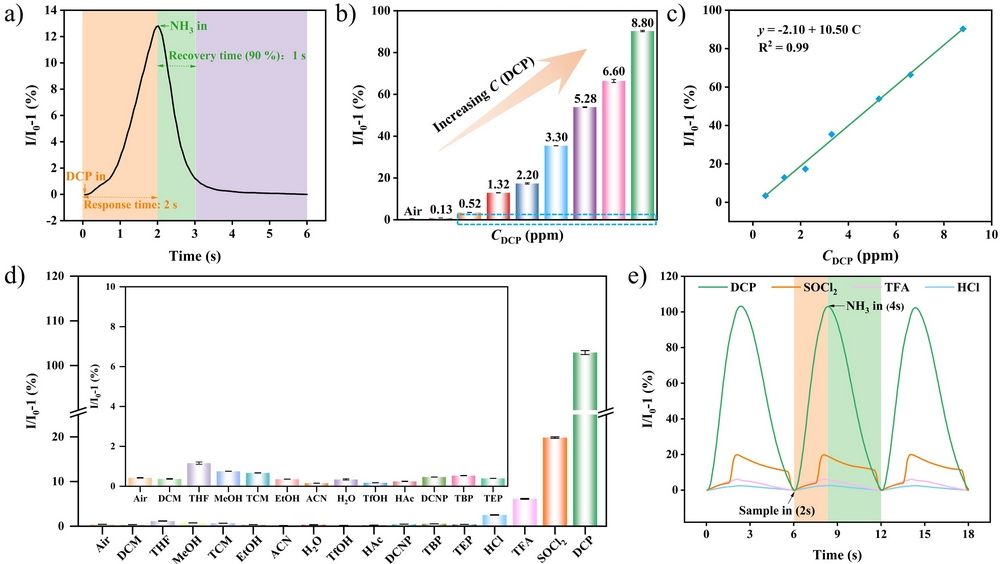
Fig. 2. (a) The response-recovery transient curve of the nanofilm upon exposure to DCP vapor (1.32 ppm); (b) Sensor responses of the nanofilm toward DCP vapors at different concentrations, with error bars representing the standard deviation of three independent measurements; (c) The linear relationship between the response intensity and DCP concentration; (d) Comparative responses of the nanofilm to saturated DCP vapor and selected potential interferents under identical conditions, with the inset showing the response intensity of the nanofilm to some common organic solvents, water, acidic compounds, and analogues of the nerve agent; (e) Dynamic response traces of the film sensor toward gaseous HCl, TFA, SOCl2 and DCP. The used NH3 is saturated vapor at ca. 60000 ppm. (Note: all the responses were monitored at 550 nm).
First Authors: Tian Yaqin, master’s student, and Yan Zhen, doctoral candidate, Shaanxi Normal University
Correspondence Authors: Prof. Ding Liping and Assoc. Prof. Zhu Xiaolin, Shaanxi Normal University
Full Text Link: https://doi.org/10.1021/acsami.6c05572
Correspondence Authors: Prof. Ding Liping and Assoc. Prof. Zhu Xiaolin, Shaanxi





 Latest Updates
 Hot Text Ranking