Xinyu Gou, Xue Gu, Zhaolong Wang, Binbin Zhai, Hongyan Xu, Lingya Peng, Xingmao Chang*, Taihong Liu*, Liping Ding*, Yu Fang*. Nat. Commun., 2026, 17, 5589, DOI: https://doi.org/10.1038/s41467-026-74956-3
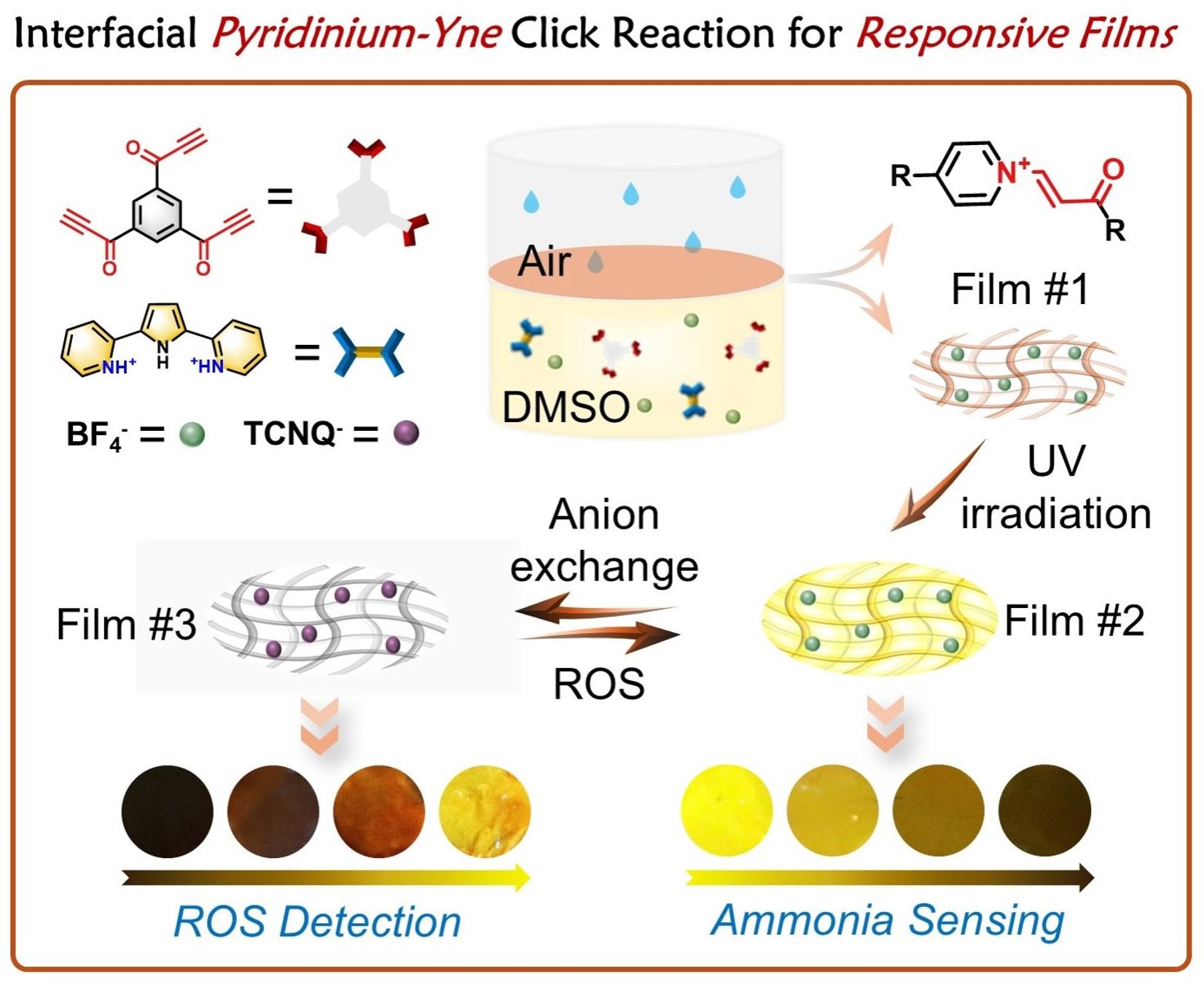
Multi-responsive organic polymer films have attracted extensive attention in various fields including molecular storage and separation, catalysts, energy storage, sensing, and phototherapy due to their tunable design features and broad monomer scope. However, most interfacial polymerizations rely on dynamic covalent reactions. Some require specific catalysts and elevated reaction temperature. Therefore, there is an urgent need for developing a catalyst-free, atom-economical, and efficient interfacial polymerization strategy under ambient conditions to fabricate free-standing organic polymer films.
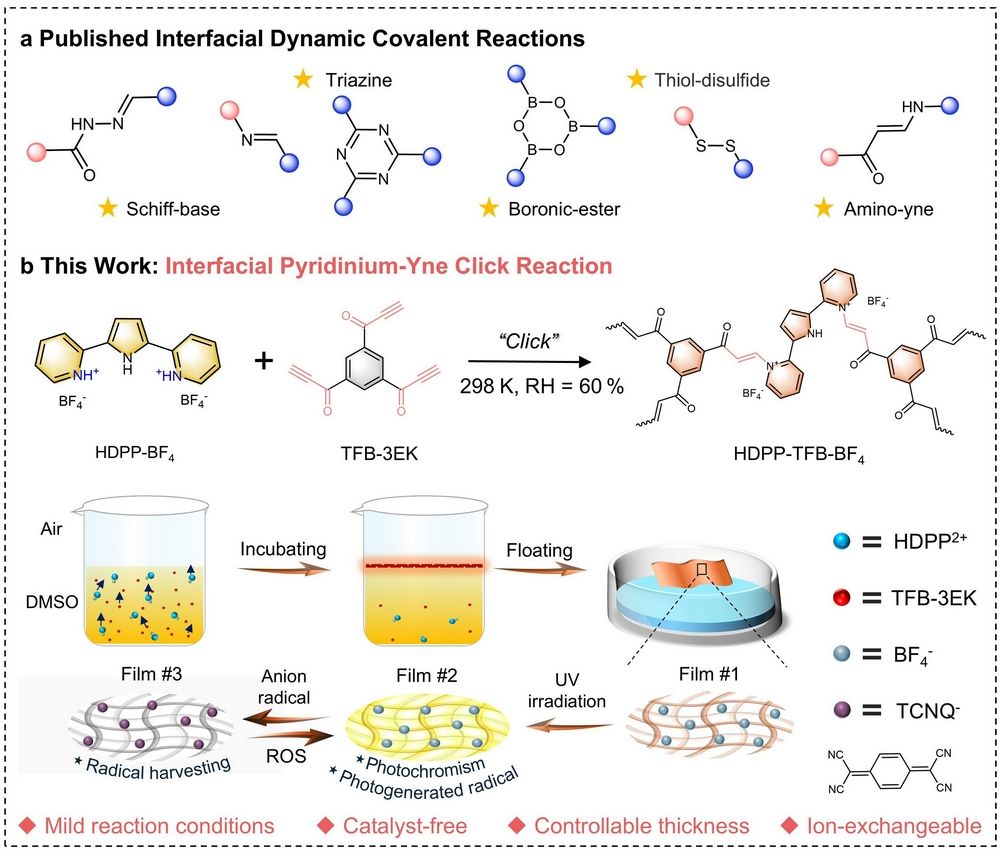
Figure 1. Representative interfacial polymerization reaction used for film preparation. a Representative interfacial polymerization reaction types at an air-liquid interface;b Schematic illustration of the interfacial preparation of HDPP-TFB-BF4 (Film #1) via pyridinium-yne click chemistry and its conversion to Films #2 and #3.
Herein, we pioneered an innovative interfacial pyridinium-yne click polymerization strategy to in situ fabricate uniform, defect-free, and large-area films. Using pyridinium salt (HDPP-BF4) as an acceptor and tricarbonylbenzene activated alkyne (TFB-3EK) as a donor, a free-standing HDPP-TFB-BF4 film (Film #1) with precisely tunable thickness from tens to hundreds of nanometers was formed at the air-DMSO interface. Interestingly, Film #1 exhibited promising photochromism, showing a 100 nm hypsochromic shift and a 5-fold fluorescence enhancement under continuous UV irradiation, which induced the formation of a radical-based Film #2. Film #2 served as a portable visual sensing platform for gaseous ammonia, achieving a detection limit as low as 0.16 ppm, and was successfully applied as a colorimetric chart for seafood spoilage. Strategically, an anion exchange of Film #2 with TCNQyielded a fluorescencesilent Film #3, which enabled efficient detection and elimination of reactive oxygen species through turn-on fluorescence visualization. This work not only provides a straightforward approach for in situ fabricating versatile polymer films but also establishes a generalizable strategy for developing multiresponsive visualization systems through the rational molecular design and controlled polymer variability.
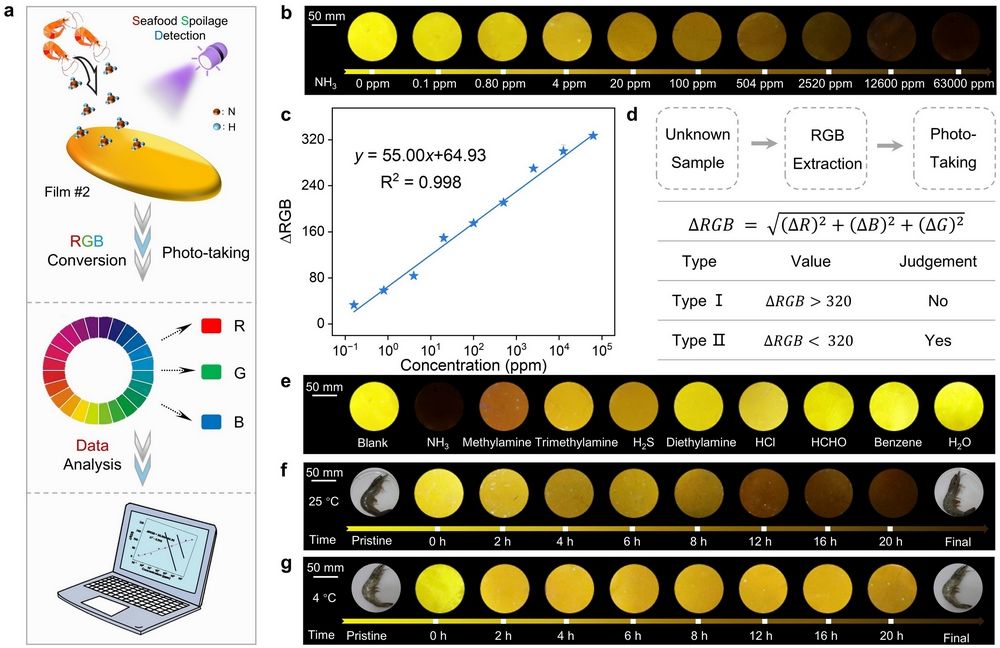
Figure 2. Sensing performance of Film #2. a Schematic illustration of RGB analysis to evaluate the content of ammonia (NH3) using the established calibration equation;b Photographs of Film #2 toward various concentrations of NH3 taken under 365 nm ultraviolet (UV) light;c Relationship between ΔRGB value of Film #2 and the concentration of NH3. d Schematic illustration of the sample evaluation process in applications. e Photographs of Film #2 toward various potential distractions under saturated vapor pressures at 25 °C. f–g Photographs of Film #2 in detecting NH3 produced by shrimp spoilage at room temperature (25 °C) and in refrigerator (4 °C) taken under 365 nm UV light.
First Author: Gou Xinyu, doctoral candidate, Shaanxi Normal University
Correspondence Authors: Prof. Fang Yu, Prof. Ding Liping, Prof. Liu Taihong, Shaanxi Normal University; Dr. Chang Xingmao, University of Ulm
Full Text Link: https://doi.org/10.1038/s41467-026-74956-3





 Latest Updates
 Hot Text Ranking